Fullerton's Active Transportation Committee (ATC) has held just three of its ten scheduled meetings in 2026, despite a City Council resolution directing the committee to meet monthly and assigning it responsibilities that extend beyond reviewing individual transportation projects. The committee, which advises the city on pedestrian and bicycle infrastructure, trails, and other forms of active transportation, has had its January, February, March, June, July, September, and October meetings canceled. According to city staff, most cancellations have occurred because there were no agenda items ready for discussion. However, emails obtained through public records requests reveal an ongoing disagreement between staff and committee leadership over which matters should be brought before the committee.
The records also show that senior city staff have discussed the possibility of folding ATC into another committee, raising questions about the future of Fullerton's dedicated active transportation advisory body. On January 21, 2025, the City Council adopted Resolution No. 2025-005, establishing the committee's current membership, meeting schedule, and responsibilities. Section 4 states: "The committee shall meet monthly on the third Wednesday of the month at 5:30 p.m. in the Fullerton Council Chamber."
The resolution also outlines nine responsibilities for the committee, including reviewing plans and policies affecting active transportation, providing recommendations on project priorities, assisting with grant applications, and serving as a stakeholder in the preparation of planning documents. Two responsibilities are particularly relevant to the recurring cancellations:
- Section 1(e) directs the committee to provide a forum through regularly scheduled meetings for residents to offer input on active transportation issues.
- Section 1(f) directs the committee to track implementation of the Mobility Element, Bicycle Element, and Bicycle Master Plan.
These are ongoing responsibilities that do not necessarily depend on new construction projects becoming available for review. Yet in a January 19, 2026 email to ATC Chair Anjali Tapadia, Community and Economic Development Director Sunayana Thomas explained that ATC was not required to meet every month. Thomas described the committee as providing one-time input on policy and project matters when staff brings them forward or when City Council directs review. That interpretation appears narrower than the responsibilities outlined in the council's resolution, particularly its provisions for tracking plan implementation and participating in planning efforts.
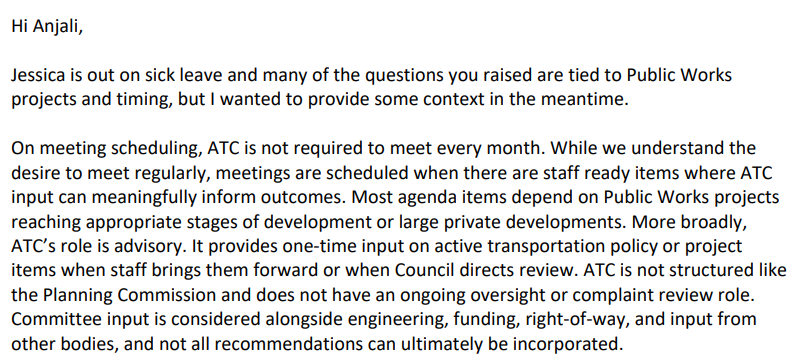
Email from Director Thomas stating that ATC is not required to meet every month
Emails dating back to November 2025 show that Tapadia has repeatedly contacted city staff requesting explanations for cancellations and identifying potential agenda items. In Tapadia’s response to Director Thomas’ email, she reported that eight of the previous thirteen scheduled meetings had been canceled. She also challenged staff's description of ATC as a body that provides one-time input, arguing that certain projects merit continued review as designs progress.
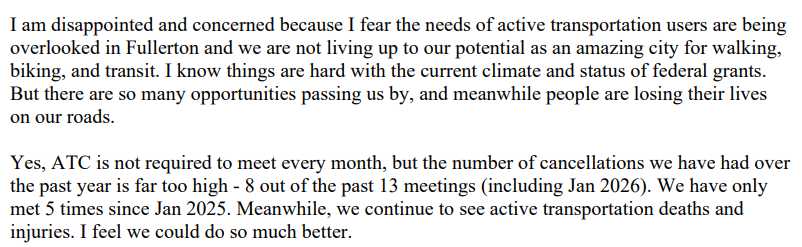
Tapadia’s response to Thomas regarding the frequent cancellations
The recurring explanation that there are no available agenda items is difficult to reconcile with several major policy and infrastructure matters considered by City Council this year. For example:
- Parks Master Plan: The planning process includes trails, park accessibility, and safe routes to parks. These subjects overlap with ATC's responsibilities.
- Open Space and Conservation Element: Brought to Council in June, this General Plan update includes an entire goal focused on accessibility and trail connectivity, including multimodal access, shared-use pathways, and a rail-to-trail strategy.
These are planning matters that could benefit from specialized active transportation input. Not every street project or parks policy necessarily requires ATC consideration. However, the committee's adopted responsibilities expressly include reviewing relevant plans, policies, and projects. The question is why these subjects were not referred to ATC while committee meetings were repeatedly being canceled for lack of business.
The committee's earlier review of Associated Road also illustrates the importance of considering member recommendations. During that review in 2023, Tapadia proposed narrowing an 11-foot vehicle lane to 10 feet to match the adjacent 10 foot lane and expanding a proposed six-foot bicycle lane to seven feet. Staff raised concerns that a wider bicycle lane could be mistaken for parking. Following a fatal collision along Associated Road in 2025, the city subsequently reduced the 11-foot vehicle lane to 10 feet while adding a one-foot buffer between the bicycle lane and vehicle traffic. Although the later buffer is not identical to Tapadia's earlier proposal, the sequence raises questions about how alternative safety improvements were evaluated and why recommendations were initially considered infeasible.
The public records also reveal another potentially significant development. In a January 19, 2026 email to Deputy City Manager Daisy Perez and City Manager Eddie Manfro, with Public Works Director Stephen Bise copied, Thomas discussed the need to establish a consistent understanding of what should come before ATC. She wrote: "Until a decision on how the committee evolves into an existing committee or other concept, we need to be on the same page regarding what does and does not go before the ATC."
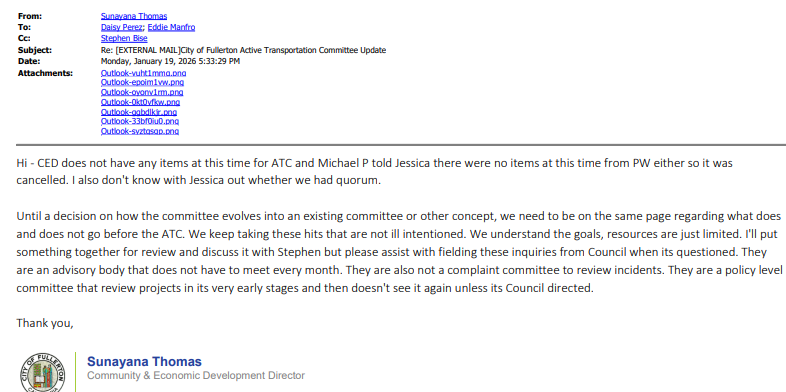
Internal email discussing the future of the Active Transportation Committee
In a separate January email to Mayor Fred Jung, Chris Norby expressed the view that the committee's continued existence was unnecessary and that its functions could be absorbed into the Transportation and Circulation Commission (TCC). TCC already handles a broad range of transportation issues, including roadway circulation, traffic regulations, and parking matters. Consolidation could reduce administrative responsibilities, but it would also eliminate a separate forum dedicated specifically to walking, bicycling, and other forms of active transportation.
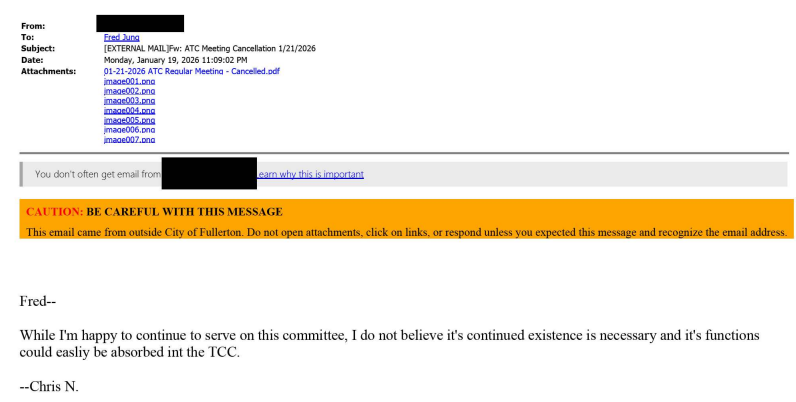
Email from Chris Norby to Fred Jung, advocating for ATC to be absorbed into the Transportation and Circulation Commission (TCC)
The internal correspondence does not establish that city staff are deliberately canceling meetings to facilitate consolidation. Nor does it establish that the City Council has decided to eliminate ATC. It does, however, show that discussions about the committee's future were occurring while staff continued limiting its agenda largely to projects that reached particular stages of development.
During the October 20 City Council meeting, staff responded to concerns about the frequent cancellations, stating that the department does not currently have a transportation planner because of budget constraints. Staff explained that projects are generally brought before ATC once they reach a suitable design stage and that engineering considerations, staffing, and coordination with Public Works affect when presentations can occur. These explanations identify real administrative challenges, but the central concern is not whether every individual cancellation can be explained. It is whether the cumulative result is consistent with the council's decision to maintain a dedicated advisory committee with regularly scheduled meetings and ongoing responsibilities.
Fullerton has significant opportunities for active transportation, including Cal State Fullerton, the Fullerton Transportation Center, the Fullerton Loop, and numerous recreational trails. Connecting those destinations with convenient and safe walking and bicycling infrastructure requires sustained planning and coordination.
Tapadia also emphasized the importance of the committee as a forum for public participation, particularly for residents with mobility impairments whose transportation needs may otherwise be overlooked. She explained that she regularly closes her clinic early to attend ATC meetings, sacrificing income and arranging her personal schedule around her commitment to the committee. Other residents and committee members similarly lose opportunities to participate when meetings are repeatedly canceled.
The Active Transportation Committee was established to provide specialized recommendations and public input on these subjects. Its role is advisory. It does not have authority to approve construction projects or independently allocate city funding, but that is precisely why its meetings matter: the committee provides an opportunity for residents and appointed members to identify needs, examine proposals, and communicate recommendations to the people responsible for making decisions.
The city may face legitimate staffing and financial limitations, but changing the committee's intended responsibilities or meeting schedule is a matter for City Council to consider. With seven of ten meetings canceled this year, the question remains whether Fullerton is providing the administrative support necessary to implement the advisory process its council established. If the city believes ATC should meet less frequently or perform a narrower role, that decision should be addressed openly by the City Council rather than becoming the practical result of repeated meeting cancellations
