Preview: 6/16/26 City council meeting
Fullerton City Council’s June 2 meeting includes several routine administrative items, but also a few decisions with broader policy implications. Council will consider fee waivers for community events, approve major infrastructure work, adopt a traffic safety plan needed for future federal grant eligibility, and update meeting rules in response to new state Brown Act requirements.
Meeting Summary
Fullerton City Council’s June 16 meeting will include a presentation of the findings from the audit conducted by Grant Thornton, a final vote on the Builder’s Remedy project off of Hermosa, a discussion of the Open Space plan for the city, and a continuing resolution to authorize spending past the current fiscal year.
View the full agenda and staff attachments here: Fullerton City Council Agenda
Presentations
Audit Update
Grant Thornton will be presenting their findings from task one of their financial audit. This audit was initiated following a budget error and recently allocated unassigned funds that resulted in a $10 million gap from what was expected.
Public Hearings
1. Appeal of Planning Commission Denial of West Hermosa Devlopment
This will be the final vote on the appeal of the Planning Commission’s denial of a City Ventures housing development. This development is a Builder’s Remedy project, a special type of development that overrides local zoning and other regulations. These projects are triggered when a city’s housing plan is not compliant with state law. Builder’s Remedy projects may only be denied if there is a written heath or safety standard that is violated by the project and cannot be reasonably mitigated.
Regular Business
2. Open Space and Conservation Element
This adopts an updated Open Space and Conservation Element for the city’s General Plan, replacing the existing Chapter 19, which has not had a comprehensive update since 2012. The update is partly required by newer state laws, including SB 1425, which requires cities to address open space access, climate resilience, and rewilding opportunities, and AB 1889, which relates to wildlife connectivity.
The element covers parks, trails, natural open spaces, habitat conservation, urban canopy, climate adaptation, green infrastructure, and open space equity. Staff says Fullerton has 1,383 acres of public open space, about 10% of the city’s land area. The plan has seven major goals, including responsible open space management, future open space planning, habitat conservation, trail connectivity, rewilding, climate adaptation, and community partnerships.
3. Continuing Spending Resolution
This is a temporary spending authorization because the city has not yet adopted its FY 2026-27 budget before the new fiscal year begins on July 1, 2026. It allows the city to keep spending at existing FY 2025-26 levels so basic operations, payroll, contracts, utilities, maintenance, debt service, and capital projects can continue until the new budget is adopted.
Staff says the proposed FY 2026-27 budget is expected to go to a July 14 budget study session, with adoption anticipated on July 21, 2026, after two community budget meetings. The resolution does not create new programs, add staffing, or increase spending authority beyond the prior-year budget level.
Consent calendar (Items 4-19)
The consent calendar are typically routine items that are passed in bulk by the City Council. Any item can be pulled from the consent calendar by a single City Councilmember for a separate vote and/or discussion
-
The minutes of the prior City Council meeting. This documents the events that took place in writing
-
The City Council will receive a monthly update on Fullerton’s boards, commissions, and committees, including attendance records from May 2026. This is mostly an informational item meant to track committee activity and whether appointed members are meeting attendance requirements.
-
Council will receive the City’s May 2026 payment report, which lists checks, electronic payments, payroll transfers, and other transactions. The total amount reported for April payments is about $15 million. This item does not approve new spending, it just publicly records payments already made.
-
This would require campaign finance forms, like FPPC Forms 460, 470, 496, and 497, to be filed electronically through NetFile instead of on paper. Staff says this will reduce staff workload, improve public access, and make it easier for candidates and committees to file accurately. The annual NetFile bundle would cost $6,250 per year, already included in the budget.
-
This formally calls the November 3, 2026 election for Fullerton City Council Districts 3 and 5, requests that Orange County run/consolidate the election, and sets candidate statement rules. Staff recommends sticking with the traditional 200-word candidate statement limit instead of allowing 400 words. Estimated election cost is $69,375 to $83,813. Candidate filing opens July 13, 2026 and closes August 7, 2026, unless an eligible incumbent does not file, in which case it extends to August 12, 2026
-
This creates a new city job classification: Principal Revenue Manager, paid at $57.33 to $73.17 per hour. The role would oversee city revenue programs like business licenses, utility billing, transient occupancy tax, franchise revenues, fees, collections, parking revenue, short-term rental regulations, and Successor Agency responsibilities. Staff says the current budget already has enough funding for the change.
-
This approves a required federal tax-law step allowing the California Statewide Communities Development Authority to issue up to $180 million in tax-exempt bonds for the acquisition and rehabilitation of two apartment complexes near CSUF: UCE Apartment Homes at 600 Langsdorf Drive and UCA Apartment Homes at 2404 Nutwood Avenue. Together, these are 395 existing units. The proposal would restrict 40% of units to households at or below 60% AMI and 60% to households at or below 80% AMI. Staff says there is no fiscal impact or liability to the City
-
This keeps Fullerton eligible for Orange County Measure M2 transportation funding. The city expects about $3.3 million in FY 2026-27 Local Fair Share funds for street improvements and related transportation work. To remain eligible, the city must approve items like its Seven-Year Capital Improvement Program, Pavement Management Plan, Local Signal Synchronization Plan, and meet a $5.9 million maintenance-of-effort requirement.
-
This adopts an Emergency Evacuation Annex into Fullerton’s Emergency Operations Plan. It lays out roles, responsibilities, procedures, evacuation strategies, public warning systems, transportation, sheltering, re-entry, and support for people with access and functional needs. Staff says there is no fiscal impact, but adoption helps coordinate emergency response and maintain eligibility for state and federal disaster assistance. Some tactical evacuation route maps are redacted as law-enforcement-sensitive
-
This adopts Fullerton’s 2026 Local Hazard Mitigation Plan, which identifies major risks to the city and lays out long-term strategies to reduce disaster impacts. The plan ranks earthquakes, wildfire/urban fire, extreme weather, and human-caused hazards as high-priority risks. FEMA and Cal OES already reviewed the plan and found it eligible for final approval, but City Council still needs to formally adopt it. There is no fiscal impact, and adoption keeps the city eligible for FEMA hazard mitigation grants.
-
This appropriates $665,000 in Measure M2 funds as the city’s local match for the Nutwood Avenue Bicycle and Pedestrian Mobility Enhancement Project. The larger project is funded by a $7.14 million State Active Transportation Program grant accepted in 2023. Staff expects design approvals by the end of 2026, bidding in early 2027, and construction around summer 2027, depending partly on CSUF coordination.
-
This authorizes another up to $500,000 purchase order with Ardurra Group for construction inspection and management services on the SiFi fiber optic network project, plus up to 15% / $75,000 in change orders if needed. Staff says the cost is fully reimbursed by SiFi, making it cost-neutral to the city. The current purchase order is expected to run out because the SiFi project has had delays and will likely continue into FY 2026-27.
-
This extends the city’s on-call traffic engineering agreement with LG2WB Engineers, doing business as Linscott, Law & Greenspan, for one more year, not to exceed $120,000. They help with traffic signal design, signal synchronization, operations, programming, timing, inspections, private development review, and staff augmentation. Staff says this is the final extension and that they plan to issue a new RFP in FY 2026-27.
-
This awards a $1,414,000 contract to Onyx Paving Company for rehabilitation of Raymond Avenue between Burton Street and Orangethorpe Avenue, north of the 91. The project includes pavement work, curb/gutter repairs, sidewalk and driveway approach repairs, ADA ramps, and sidewalk installation. The road’s Pavement Condition Index is currently 37, which is “very poor,” and staff says it would reset to 100 after completion. Part of the project is in Anaheim, and Anaheim would reimburse Fullerton for work in its jurisdiction. Staff also wants to allow nighttime construction from 8 p.m. to 5 a.m. to reduce traffic impacts.
-
This awards a $239,167.27 contract to Petrochem Materials Innovation for slurry seal work in several neighborhoods. Funding comes from remaining ARPA street funds and Measure M2 funds. Staff says the city has $63,923 in ARPA funds remaining that must be spent by December 30, 2026, so they want to use it on this smaller street project. The proposed areas include the Richman-Houston-Woodcrest area, Hill-Malden-Ray area, and San Carlos-Balfour area, with a focus on southerly streets.
-
This approves professional services agreements totaling up to $335,750 for a three-cycle firefighter wellness program. Bio-Care would provide NFPA 1582 occupational medical evaluations for up to $252,000, and Hoag would provide Galleri multi-cancer early detection blood testing for up to $83,750. The program is mostly funded by a federal Assistance to Firefighters Grant: $305,227.27 federal funding with a $30,522.73 city match. Participation is voluntary, and individual medical results stay confidential between the provider and firefighter; the city only gets aggregate/de-identified data and billing records.
Preview: 6/2/26 City council meeting
Fullerton City Council’s June 2 meeting includes several routine administrative items, but also a few decisions with broader policy implications. Council will consider fee waivers for community events, approve major infrastructure work, adopt a traffic safety plan needed for future federal grant eligibility, and update meeting rules in response to new state Brown Act requirements.
Meeting Summary
Fullerton City Council’s June 2 meeting includes several routine administrative items, but also a few decisions with broader policy implications. Council will consider fee waivers for community events, approve major infrastructure work, adopt a traffic safety plan needed for future federal grant eligibility, and update meeting rules in response to new state Brown Act requirements.
View the full agenda and staff attachments here: Fullerton City Council Agenda
Consent calendar (Items 1-8)
The consent calendar are typically routine items that are passed in bulk by the City Council. Any item can be pulled from the consent calendar by a single City Councilmember for a separate vote and/or discussion
-
The minutes of the prior City Council meeting. This documents the events that took place in writing
-
The City Council will receive a monthly update on Fullerton’s boards, commissions, and committees, including attendance records from April 2026. This is mostly an informational item meant to track committee activity and whether appointed members are meeting attendance requirements.
-
Council will receive the City’s April 2026 payment report, which lists checks, electronic payments, payroll transfers, and other transactions. The total amount reported for April payments is about $15 million. This item does not approve new spending, it just publicly records payments already made.
-
The City is considering whether to leave its current risk management and insurance pool, ICRMA, because the pool has been shrinking and costs may rise as fewer cities remain. This action would not force Fullerton to leave, but it would preserve the City’s option to withdraw in 2027 if staff finds a better insurance arrangement.
-
The Fullerton Museum is asking the City to waive up to $3,187.50 in City support costs for the 2026 Pride Festival. The event would include activities like a bike parade, live entertainment, vendors, food, and community programming in and around Downtown Plaza. If approved, the City would absorb costs for staffing, cleaning, and police support.
-
The Day of Music Committee is requesting up to $10,741.25 in waived City fees and support costs for Fullerton’s annual citywide music festival. The event would include performances at several locations, including Downtown Plaza, Walk on Wilshire, Independence Park, and Hillcrest Park. The largest portion of the request is for police staffing, along with facility fees, street closure support, cleaning, and setup costs.
-
The City is proposing to spend $163,259 to convert 42 streetlights in the Derek circuit area to solar-powered lighting. These lights are part of an aging high-voltage streetlight system that has become difficult to maintain, and the area has experienced long outages due to transformer problems. Staff says switching to solar would improve reliability and reduce dependence on outdated equipment.
-
The City is considering a $2.63 million contract with R.J. Noble Company to repair about 2.8 miles of deteriorated residential streets in the Sunny Hills, Twilight, and East Las Palmas area. The project would repave streets, repair curbs, gutters, sidewalks, driveway approaches, ADA ramps, sewer manholes, and some sewer lines. Construction is expected to begin in July 2026 and finish around October 2026.
Regular Business (items 9 & 10)
9. Safe Streets and Roads for All Safety Action Plan
The Safe Streets and Roads for All item is approving Fullerton’s traffic safety roadmap so the City can remain eligible for federal implementation grants.
At the basic level, the City received a $200,000 federal SS4A planning grant, plus used $50,000 in Gas Tax funds, to develop a citywide Safety Action Plan. The plan is supposed to identify where Fullerton has the greatest roadway safety problems and what types of improvements could reduce fatal and serious injury crashes. Council has to adopt the plan by June 30, 2026, or the City risks forfeiting the federal planning money and having to cover those costs itself.
Policy-wise, the key thing is that this item is about grant eligibility and strategic positioning. The federal SS4A program has two stages: planning grants and implementation grants. Fullerton already got the planning grant. But to apply for future implementation grants, the City needs an eligible adopted Action Plan. So adopting this plan is basically the gateway step that lets Fullerton compete for future federal money to actually build safety projects.
The agenda report frames the goal as reducing fatal and severe injury collisions through “low-cost, high-impact strategies” across the city, including in disadvantaged communities. The plan is supposed to rely on crash data, claims history, existing transportation plans, public input, and committee review. Staff says it drew from the General Plan, Bicycle Master Plan, Local Roadway Safety Plan, Downtown Fullerton on the GO plan, OCTA plans, citywide collision data, and claims history
10. SB 707 Brown Act Updates
The City Council will consider updates to its meeting rules to comply with new state Brown Act requirements under SB 707. The changes include rules for what happens if remote public access fails during a meeting, continued two-way remote participation for the public, and efforts to encourage participation from groups that do not traditionally attend city meetings. Staff is recommending the same technology disruption policy for Council and City boards, commissions, and committees.
Recap: 5/5/26 City Council Meeting
This City Council meeting featured several controversial items, including the appeal of a denied Builder’s Remedy housing project, concerns over the funding and accessibility of the State of the City event, questions about a noncompetitive energy audit proposal, and a failed effort to discuss disclosure rules for street repair projects near councilmember homes.
Across the meeting, a familiar divide emerged between councilmembers pushing for more transparency, legal caution, and procedural safeguards, and councilmembers resisting additional review or policy changes. The most consequential vote was the council’s decision to uphold the Planning Commission’s denial of the Harbor and Hermosa housing project, despite staff confirming that the denial did not identify the kind of specific health or safety risk required under state law.
Meeting Summary
This City Council meeting featured several controversial items, including the appeal of a denied Builder’s Remedy housing project, concerns over the funding and accessibility of the State of the City event, questions about a noncompetitive energy audit proposal, and a failed effort to discuss disclosure rules for street repair projects near councilmember homes.
Across the meeting, a familiar divide emerged between councilmembers pushing for more transparency, legal caution, and procedural safeguards, and councilmembers resisting additional review or policy changes. The most consequential vote was the council’s decision to uphold the Planning Commission’s denial of the Harbor and Hermosa housing project, despite staff confirming that the denial did not identify the kind of specific health or safety risk required under state law.
Appeal Of Planning Commission Denial
Mayor Jung moved to push public comments and the consent calendar to the end of the meeting in order to hear this item first. The motion passed unanimously.
Housing and Economic Development Director Sunayana Thomas and Senior Planner David Lopez gave a joint presentation on this item. They explained that the Planning Commission voted to deny a Builder’s Remedy housing development at Harbor and Hermosa. The developer appealed their decision, arguing that they did not have a legitimate reason to do so under state law.
Builder’s Remedy allows a developer to bypass local zoning and general plan requirements if they submit the application while the city does not have a compliant housing plan. City Councils may only deny a Builder’s Remedy project if there is a written, quantifiable, direct, and specific, health or safety risk.
Councilmember Zahra asked Lopez if the Planning Commission identified a risk that would meet that criteria. Lopez said no. Zahra explained that the decision is about whether the Planning Commission met that threshold, which they did not, so he will be voting to overturn their decision.
Councilmembers Jung and Valencia asked staff why a traffic study was not performed. Staff replied that the project did not generate enough traffic to warrant a traffic study.
Mayor Pro Tem Dunlap spoke about vehicle collisions in the area, saying that this development would exacerbate those issues. Zahra challenged him on this, asking whether there is any data to support that claim. Dunlap responded that staff did not acquire that data.
Councilmember Valencia asked whether the developer would consider undergrounding utilities. Councilmember Charles clarified that the current project’s utilities are underground, and what Valencia is requesting is for the developer to underground the neighbor’s utilities. The developer responded that performing this would potentially derail the project, as they would need permission from neighboring property owners. So they waived that requirement as one of the concessions they receive under state law. Jung then made a motion to approve the development contingent on the developer acquiring that waiver locally rather than from the state.
Both Zahra and Charles objected to this, stating this is needless bureaucracy. The developer also objected to this condition. The motion failed 2-3 (Jung and Valencia in favor).
Dunlap made a motion to deny the appeal and uphold the denial of the project. This motion passed 3-2 (Zahra and Charles opposed) and will return June 16 for the final vote.
State of the City
City staff gave a presentation on the upcoming State of the City event. This event is a keynote speech given by the Mayor on recent city accomplishments, upcoming challenges, and future priorities. Its purpose is to operate as a tool for public transparency and civic engagement, keeping the public informed on where the city is headed.
Zahra raised concerns about the funding sources for the event. 8/9 sponsors have current or recent contracts with the city, while the 9th sponsor is a contributor to Jung’s campaign. He requested a discussion on implementing policies on how sponsorships are handled in order to avoid potential conflicts of interest. He also expressed support for lowering the barrier to entry for the public, stating that the exclusive venue and ticket costs make it unfeasible for all members of the public to attend. Zahra made a motion, seconded by Charles, to have a discussion on these potential policies.
Valencia and Jung argued that the anyone is allowed to sponsor the event and that the donations allow the city to make a small profit from the event. Valencia then made a substitute motion, seconded by Jung, to have the State of the City as-is. The substitute motion failed 2-3 with Jung and Valencia in support. Zahra’s original motion failed 2-3 with Zahra and Charles in support. Dunlap was the sole councilmember to oppose both motions.
Dunlap made a motion to keep this year’s State of the City event as-is, but bring back a discussion on the policies for future years. Zahra asked if the council could review this year’s State of the City address (the mayor’s speech) for approval as the statements being made are representative of the current state of the city. Dunlap opposed and kept his motion unchanged. His motion passed 3-2 with Zahra and Charles opposed.
Veregy Energy Audit
Zahra pulled this item from the consent calendar to get more context. Public Works Director Bise explained that Veregy had been lobbying the city for about 2 years. They are looking to perform an audit of the city’s energy supply to see if there are any cost savings or efficiencies in the current infrastructure. Bise stated that this was not a priority for the city, but when the company offered to perform the initial audit for free, he figured it was a low buy-in project that could reveal savings.
Zahra asked why this wasn’t a competitive process, which Bise explained was due to the cost and time needed to develop an RFP, and the fact this wasn’t a staff priority. Zahra then asked the representative from Veregy, Ryan Gunstream, why the city needs another energy audit when they just had one a few years ago with Noresco, a company Gunstream worked for at the time. Gunstream stated that Noresco made a number of recommendations to the city yet not all the recommendations were selected, so there are additional savings possible.
Zahra explained how with the previous project, there was a competitive process where every company offered a free audit, so he doesn’t understand why this is not the case this time.
Charles moved, seconded by Jung, to approve the item. Motion passed 4-1 with Zahra opposed.
After the meeting, it was discovered that Placentia Mayor Chad Wanke is a lobbyist for Veregy and met with Jung twice before this vote. Wanke gave the maximum contribution to Jung’s campaign on December 31, 2025. A PAC which he serves as the principal officer and treasurer made a donation of $2430 to Jung’s campaign following the vote.
Council Reports
Zahra
Zahra spoke about how the City Council has not demonstrated kindness in the policies they implement, often prioritizing campaign donors over the community. He then shared how a student veterans club at Fullerton College is having a fundraiser in partnership with Raising Canes.
Charles
Charles spoke about Mother’s Day and mental health services. She then spoke about a vote on the street projects last meeting, stating she was not aware that multiple planned projects are adjacent to councilmember homes. She then asked to agendize a discussion about disclosure rules regarding street projects, which Jung opposed. Jung said that he did not want to disclose where he lives for safety reasons. Dunlap also opposed agendizing this discussion, stating that the process to select roads to repair is thorough and comprehensive. Jung made a motion to not agendize the discussion which passed 3-2 (Zahra and Charles opposed).
Preview: 5/5/26 City council meeting
The April 21 Fullerton City Council meeting will focus mainly on how the city plans to spend money on fixing roads, along with updates on staffing shortages and a proposal to regulate kratom sales. Council will also review some administrative updates, like reorganizing the city’s municipal code. There will also be a presentation on the planned forensic audit
Meeting Summary
City Council is dealing with two core issues this meeting: a legally risky housing decision and an ongoing budget crisis, while handling routine operations and long-term planning. The council will decide whether to approve a state-protected housing project that was previously denied, and continue a major independent financial review that could escalate into a forensic investigation.
Alongside that, the agenda includes lower-stakes items like exploring a potential LAX transit connection, studying energy-saving infrastructure upgrades, and adopting required long-term water planning documents. The rest consists of standard city business; contracts, infrastructure maintenance, and minor ordinance updates.
View the full agenda and staff attachments here: Fullerton City Council Agenda
Consent calendar (Items 1-9)
The consent calendar are typically routine items that are passed in bulk by the City Council. Any item can be pulled from the consent calendar by a single City Councilmember for a separate vote and/or discussion
-
The minutes of the prior City Council meeting. This documents the events that took place in writing
-
This reorganizes and updates Fullerton’s existing laws into a clearer, consolidated municipal code without making major policy changes. It’s basically a cleanup and restructuring of current rules.
This was approved last meeting, but since it is an ordinance, must be voted on twice
-
This adds rules to restrict or prohibit the unlawful sale and distribution of kratom products in Fullerton for public safety reasons. It creates a new section in the municipal code specifically addressing kratom.
This was approved last meeting, but since it is an ordinance, must be voted on twice
-
The city is reporting it has about $191M in investments earning ~4.19% and is updating its investment rules to better align with state law and reduce risk. The changes mainly improve oversight, diversification, and flexibility in how funds are managed.
-
The city is responding to a Grand Jury recommendation to explore a direct bus (like FlyAway) from Fullerton Park & Ride to LAX and will study whether it’s feasible. No money is committed yet, just starting collaboration and analysis.
-
The city is hiring Grant Thornton Advisors LLC to continue an independent review of its finances, including budget optimization and possibly a deeper forensic investigation if issues are found. This authorizes the City Manager to approve the forensic audit if there are significant findings
-
The city is considering hiring Veregy Pacific LLC to analyze buildings and infrastructure for energy-saving upgrades that could potentially pay for themselves over time. This is just a study phase; no projects are approved yet.
-
Fullerton and La Habra are partnering to repair and upgrade a shared stretch of road, with costs split based on jurisdiction. Fullerton will lead the project, which includes pavement, sidewalks, and accessibility improvements.
-
The city is extending its contract with Sweeping Corporation of America for one more year to avoid service disruptions while transitioning to a new sweeping schedule and preparing a new long-term contract.
Public Hearings (items 12 & 13)
A public hearing is a formal part of a council meeting where the public is specifically invited to speak on a particular item before the council makes a decision (or receives a report). Everything said in a public hearing becomes part of the official record and can be used in legal challenges against the decision of the City Council
12. Appeal of Planning Commission Denial Of Development at Harbor x Hermosa
What This Is: This is a developer (City Ventures) appealing the Planning Commission’s denial of a 32-unit townhouse project (with 5 affordable units), asking City Council to override that denial. This is not a normal housing vote, as this qualifies as a Builder’s Remedy project.
Deeper Dive: The state requires that every city adopt a plan to provide housing. These plans are called Housing Elements. If the plan is insufficient or is not implemented, the state can decertify the housing plan. This opens the city up to Builder’s Remedy projects, which allows developers to override local zoning and development laws, and takes away much of City Council’s discretion.
In 2022, Fullerton’s Housing Element was decertified, which allowed this project to be filed under Builder’s Remedy.
City Council may only deny this project if there is a documented health or safety risk that is:
Caused by the development
Not easily mitigated
As it stands now, there are no findings by staff that would support denial. If City Council denies this project anyway, they will be forced to litigate in court where the developer will likely win. This would come at a cost to the city and the tax payer.
13. Urban Water Management & Shortage Contingency Plans
What This Is: This is a required update where the city lays out its long-term water supply, demand forecasts, and drought response strategy through 2050.
Deeper Dive: The plan shows Fullerton expects stable water supply and slightly decreasing demand over time, with a mix of ~63% groundwater and ~37% imported water, and includes a structured 6-stage drought response system with escalating conservation mandates (up to 60% reductions in extreme shortages).
Regular Business
14. State of the City 2026
What This Is: The city is reviewing last year’s State of the City event and deciding how to run it in 2026, with staff recommending the same model using sponsorships and ticket sales instead of taxpayer funds.
Deeper Dive: Staff claims that the State of the City made a profit of $29k last year through donations and ticket sales. This however does not account for staff time nor funds outside of the city’s general fund. More concerning however, is the list of donors:
Jones & Mayer: $2500
This company is contracted to the city for legal services
Happy Jewelers: $2500
This company’s CEO is a major campaign contributor to Mayor Fred Jung
Kimley-Horn: $2500
This company competes for contracts that the city awards
Orange County Power Authority: $5000
This organization is a community choice aggregation. Fred Jung has sat on its board since 2021
Republic Services: $5000
This company is our current trash hauler and is currently competing for a new contract
Fullerton College: $2500
This is a local community college that frequently has to work with the city on projects
CSUF: $2500
This is a local university that frequently works with the city on projects
West Coast Arborists: $2500
This is a company that frequently works for Fullerton
Boeing: $2500
This company is currently involved in a planned air-taxi service at the airport
The way how the city is generating revenue for this event exposes them to potential conflicts of interests. Nearly every entity that has donated has a vested interest in city projects or the mayor’s campaigns.
Recap: 4/21/26 City Council Meeting
City Council received presentations on the upcoming budget audit, the 26-27 plan for road repairs, the city’s current vacancies, and updates to the municipal code. City Council voted to adopt restrictions on sales of Kratom, a drug that can act as both a stimulant or an opiate depending on the dose.
In Closed Session, City Council voted to pursue litigation against fire truck manufacturers over alleged price-fixing.
Explanations of the items being discussed can be found in the meeting preview.
Meeting Summary
City Council received presentations on the upcoming budget audit, the 26-27 plan for road repairs, the city’s current vacancies, and updates to the municipal code. City Council voted to adopt restrictions on sales of Kratom, a drug that can act as both a stimulant or an opiate depending on the dose.
In Closed Session, City Council voted to pursue litigation against fire truck manufacturers over alleged price-fixing.
Explanations of the items being discussed can be found in the meeting preview.
Audit Presentation
Grant Thornton Risk Advisory Services gave a presentation on their company and the services they can provide the city following the recently discovered budget error. They separated their services into three tasks:
Task 1: review the budget and transactions to understand what happened and why. They estimate this step could take 5-6 weeks and the cost could be around $100k
Task 2: review budget for optimization and cost-savings opportunities. They would provide an in-depth review of expenses, investment strategies, and revenue generation to make recommendations to the council on how to further optimize the funds they currently have available. This can be done at the same time as task 1 and would cost around $130k
Task 3: perform a forensic audit and deep investigation to determine the extent of fraud (if any) and provide systemic solutions. This task is recommended to be performed after task 1, as task 1 will inform the company of where in the budget to put their focus. They stated they could do this prior to task 1, but that it is more economical to allow them to narrow the scope. This could cost between $500k-$1 million depending on the extent of the issues.
Zahra asked why the firm has only met with the Mayor, City Manager, and specific staff members. They stated that the initial meeting was to acquire information for this presentation, but that they plan to meet with each Councilmember directly. He then asked whether the forensic audit would include reviewing communications and public records, to which the firm responded affirmatively. Lastly, Zahra asked how long phase 3 would take. The firm was hesitant to provide a timeline as they emphasized the time can vary greatly depending on what they find
Charles asked about the return on investment for task 2. The firm didn’t provide an exact figure but emphasized it would provide council “additional levers to pull” to help solve the deficit. She asked whether something like this has been done in the past. The City Manager says there may have been internal reviews, but that there has not been an in-depth analysis by a third-party as far as he knows.
Dunlap spoke on how he believes they need to expand the seats in the ad hoc fiscal sustainability committee, and is open to task 2. He spoke about how Orange did a similar budget analysis and that they found the results to be helpful. He also stated that he hopes any findings from task 1 are reported to council immediately so they can move forward with the audit quickly. Lastly, he expressed interest specifically in looking at the Successor Agency/Redevelopment funds in-depth as that is where the $2.9 million error originated from.
Zahra shared additional comments to the firm, stating this is about accountability and not an exercise in public relations. He said he wants this to be an objective process to find the truth and rebuild trust. The firm confirmed that they plan to do an objective analysis and have no conflicts of interest within the city.
Public Comments
The first public commenter spoke about how he was denied a contract with the city despite being the lowest bidder due to not taking action in addressing disadvantaged communities (the funds being used for this project had this legal requirement). His lawyer spoke after him stating that he is apart of those communities and thus didn’t think he needed to take additional action.
Jensen followed-up on his comments last meeting where he spoke about the WWII memorial at Hillcrest Park. He said he doesn’t want strife with the council or staff, and would like to work with them. He shared that there were redwoods planted for each name on the memorial, 55 in total, but that the last one died in 2015. He said that these redwoods can be replanted as these trees are available in the county.
One public commenter asked that council reconsider its approach to cannabis dispensaries, encouraging regulating legal cannabis shops. He said that this is a growing industry, and that it feels like council is leaving money on the table. Lastly, he discouraged fines as it disproportionately impacts lower income communities.
Payton spoke about how he is a new business owner in the city. He runs the family-owned Uptown Burger and invited people to come to their ribbon cutting on April 30th. The City Manager remarked that he thought it was a good burger.
Multiple commenters spoke about recent council decisions, including the budget error, the proposed signal light, the trash contract, and the audit.
Council Reports
Charles
Charles shared that she attended the third annual Fullerton Women’s Festival and the Mosquito Vector Control District meeting. She shared that mosquito activity is going to be higher this year, so get rid of any standing water and use bug spray. Charles agreed with a public commenter requesting more transparency and simpler explanations of the budget, saying that perhaps the new CPA firm can include that in their presentation.
Charles spoke about how she has office hours at City Hall every Thursday from 12-2, except for the last Thursday of the month where she has it at another location around Fullerton. She announced that the office hours for the last Thursday of this month would be at Tricity Park.
Charles announced that she will be having a Town Hall on food insecurity in May, as a project in collaboration with a student intern from CSUF. She said there’s not a specific date set, but to watch for that announcement soon.
Zahra
Zahra thanked Congressman Lou Correa for bringing funds to Fullerton for the Fire Department. The funds totaled to $250k that will be used to upgrade their alert system, which will improve their response time.
He responded to the commenter who spoke on cannabis, stating that he supports making cannabis sales legal to improve safety through regulations and increase revenue. He then spoke about broader policy decisions that have been made that have hurt city revenues from his perspective: lack of a strategic business plan, closing the Walk on Wilshire, bad negotiations with tenants at the train station and delays to the hotel project downtown. He spoke about how the council is not acting with a vision for the future, but rather as a reaction to donors and consultants. Zahra then said that people shouldn’t thank councilmembers for doing the right thing, but expect them to do the right thing every time. He said the budget error was downplayed by other councilmembers, and that he is happy that there are more eyes on this council now.
Zahra then spoke about a concern that was raised last meeting regarding an ADU in a preservation zone. He said he spoke with someone at Fullerton Heritage who expressed concerns with the historical aspects of the development. He requested that they agendize an update to design standards, to which Jung said that Dunlap had already agendized this. Zahra responded that Fullerton Heritage do not have this understanding of what was agendized by Dunlap.
Zahra then spoke about how he wants a discussion about the upcoming State of the City, specifically the costs and an option to cancel the event. He said this is often just a PR stunt and, given the budget situation and our road conditions, he doesn’t see what there is to brag about. Charles seconded a discussion on costs of the event.
Lastly, Zahra requested a discussion on how the City sends out cease-and-desists.
Dunlap
Dunlap shared that he attended the grand opening for Labanz Bakery, stating it was delicious. He then spoke about how Rosary High School is undertaking the next stage of their growth plan, which is an exciting moment he hopes people will follow along with.
He talked about how he wants to look into seeking damages from the auditors who missed the initial budget error, in order for the city to recuperate some of their costs.
Dunlap then responded to a public commenter who claimed that Tony Bushala was the largest contribution to his campaign, which he stated was factually incorrect.
City Vacancies
City staff gave a presentation on the current vacancies within the city. Zahra clarified that this report doesn’t reflect staffing needs, but rather is a reflection of what positions the city has budgeted for but are not filled, which staff confirmed to be the case.
Zahra then asked the City Manager about a method used in the past to balance the budget, which would leave positions intentionally vacant to save on costs. The City Manager stated that this is a common method, but imperfect in his opinion. He spoke about how these vacancies may reduce costs, but not always, as it can increase the overtime consumption of existing employees and result in more contracted consultants. He said the real cost savings isn’t clear given how leaving the positions vacant can have negative impacts in other areas.
Charles asked about the current vacancies and how the City Manager is planning future recruitment. The City Manager said, given the current fiscal situation, he is hesitant to move forward with hirings in general.
Recodification Of Municipal Code
Multiple public comments were made requesting the new draft of the municipal code be made available to the public.
Charles asked if AI was used in this process which the City Clerk said it was not. Charles then asked if the new draft will be made available, which the City Clerk responded saying that it is available in her office but not uploaded (it wasn’t confirmed explicitly but it sounded like the size of the code was a barrier to uploading it online).
SB1 Funds For Roads
Zahra asked about Commonwealth and why this road is not up for repair. Staff said that the water main is up for replacement for next fiscal year, which is when the road will be completed. Zahra expressed frustration given how this is what was said to him last year, which staff replied that the issue is following the programming of the water system.
Road Repairs For 26-27
Dunlap and Zahra expressed support for more transparency in the road repair process, to allow residents to know when their road is up for rehabilitation.
Zahra asked staff for how much money staff would need to fully rehab the city’s roads. Staff replied that to bring them to pristine condition, it would cost around $200 million. Staff said that the current funds they have now are only enough to maintain current conditions.
Charles asked about active transportation upgrades around CSUF, specifically whether any of those upgrades would be present in the rehabilitation planned for Yorba Linda. Staff said there are no plans for that currently, but that if the opportunity presents itself they will pursue those upgrades.
Charles then asked about State College and Nutwood, specifically why there are delays with those projects. Staff spoke about how working with CalTrans can be difficult, as they have very long response times. They stated that CalTrans has taken 9 months to respond in the past.
Preview: 4/21/26 City council meeting
The April 21 Fullerton City Council meeting will focus mainly on how the city plans to spend money on fixing roads, along with updates on staffing shortages and a proposal to regulate kratom sales. Council will also review some administrative updates, like reorganizing the city’s municipal code. There will also be a presentation on the planned forensic audit
Meeting Summary
The April 21 Fullerton City Council meeting will focus mainly on how the city plans to spend money on fixing roads, along with updates on staffing shortages and a proposal to regulate kratom sales. Council will also review some administrative updates, like reorganizing the city’s municipal code. There will also be a presentation on the planned forensic audit.
View the full agenda and staff attachments here: Fullerton City Council Agenda
Presentation
Grant Thornton Risk Advisory Services will be making a presentation on a Special Fiscal Audit. Limited information is available at this time, but this is certainly related to the recent budget misclassification error.
Appointments
Mayor Pro Tem Dunlap has an appointment to the Community Development Citizens Committee. This committee provides input on how to use CDBG grant funds which come from the federal government. These funds are intended to benefit low and moderate income communities, or address blight/urgent needs.
Consent calendar (Items 1-11)
The consent calendar are typically routine items that are passed in bulk by the City Council. Any item can be pulled from the consent calendar by a single City Councilmember for a separate vote and/or discussion
-
The minutes of the prior 2 City Council meetings. This documents the events that took place in writing
-
This is a report on the attendance and activity of city committees. These committees refine policy and make recommendations to City Council.
-
This is a list of every payment the city made in March. It lists who was paid, how much, and what for.
-
This item was passed last meeting but, since it is an ordinance, it must be approved twice. The second vote is almost always on the consent calendar.
This ordinance increases fines and penalties for illegal cannabis dispensaries.
-
The city is fixing a technical mistake about who officially represents Fullerton on a regional risk management board (basically the city’s insurance pool)
-
The council is required to approve the police department’s policy on using certain equipment labeled as “military.” The definition of military equipment is broad and includes things like drones and equipment used by civilians. State law requires this approval annually
-
The city is considering pursuing a lawsuit against fire truck manufacturers for potential price-fixing (anticompetitive behavior).
Here is an example given by staff of how fire truck prices have skyrocketed way beyond inflation:
1999: $339k
2015: $475k
2019: $751k
2023: $2.2 million
The city is concerned that the manufacturers may be colluding or consolidating in a way that drives up prices artificially.
This item would retain legal services to explore a potential lawsuit. The law firm would be hired on contingency, meaning there is no upfront costs, but they would receive 30% of any money received should the city decide to sue.
-
Fullerton is joining Anaheim, Brea, and Orange to sync traffic lights along State College Blvd. These projects sync up the lights so drivers hit more greens in a row, reducing congestion and travel time.
80% of the cost comes from OCTA (Orange County Transportation Authority) with Fullerton paying about $202k. This money is already budgeted for infrastructure improvements.
-
The city is approving contracts to buy and replace water meters every year. When water meters are old, they become inaccurate, meaning residents are undercharged for their water use. The city loses revenue in this case. Essentially: more accurate billing = more consistent city revenue.
This is funded by the water enterprise fund which comes from residents’ water bills. These funds have to be used on this utility service.
-
Major street repair project near Beechwood Elementary. About 1.5 miles of street. This project will fix the pavement, sidewalks, curbs, and ramps.
This street is rated very poor and will be restored to like-new conditions. Since this is near a school, the project will take place over summer break
The bid came in about 23% below what was expected. The total cost of the project is ~$1.78 million and comes from multiple funds:
$1.2 million from infrastructure fund
$605k from Measure M2 (this comes from the county sales tax and is restricted to transportation uses)
$60k from sewer fund (some of the work overlaps with sewer improvements)
$205k from the general fund (this is the fund that city council can choose how to spend throughout the year)
-
Another street rehab project (smaller area near a school + park). 0.4 miles of streets + 1 alleys. Same type of repairs as item 10. Street is in very poor condition
Total cost is $549k:
$350k from CDBG (this is federal money for low-moderate income communities)
$11k from sewer
$305k from general fund (City Council’s discretionary monies)
Public Hearings (items 12 & 13)
A public hearing is a formal part of a council meeting where the public is specifically invited to speak on a particular item before the council makes a decision (or receives a report). Everything said in a public hearing becomes part of the official record and can be used in legal challenges against the decision of the City Council
12. Vacancy Report (Recruitment & Retention)
What This Is: The city is required by state law to publicly report on staffing shortages and hiring efforts once per year. There is no action to be taken on this item; it is purely informational.
Deeper Dive: The city is still understaffed, especially at the executive level. 27% of executive positions are not filled with a permanent staff member. This is important as the executives are the decision-makers and provide oversight. Notably, Fullerton has not had a full-time finance director since Ellis Chang departed in 2025.
Another important point regarding vacancies is that they are often the first thing to be cut when a city experiences a budget deficit. These vacant positions are still budgeted for, so cities will often cut these positions because it doesn’t require laying off current staff.
13. Recodification of Municipal Code
What This Is: The city is reorganizing and cleaning up its entire municipal code (city laws). This includes renumbering sections, changing outdated language, and making it more accessible. Staff claims there are no policy changes. City Council are being asked to adopt the new municipal code
Deeper Dive: The newly drafted municipal code was not provided in the meeting materials. While staff claims that there are no policy changes, there’s no way for the public to verify that claim. Since this is an ordinance, it needs to be voted on twice to pass. Staff should include the draft municipal code at the next meeting so the public can review the changes before the new code is adopted.
Regular Business (Items 14-16)
14. SB 1 Funds Allocation
What This Is: SB 1 is a state law that raised the “gas tax” that funds road repairs. The city has ~$4 million in these funds. Staff is seeking City Council approval to spend these funds on the Rancho-Verona-Yucca neighborhood and State College.
Deeper Dive: ~$3.7 million would go to Rancho-Verona-Yucca which would rehab ~2.8 miles of streets. ~$336k would go to supplementing road repairs on State College. These streets were chosen due to their poor road quality and recent water main replacements (this is always a major factor as to replace water mains requires tearing up the road. Recent replacement → not having to tear up new road).
The location of the two repairs is below
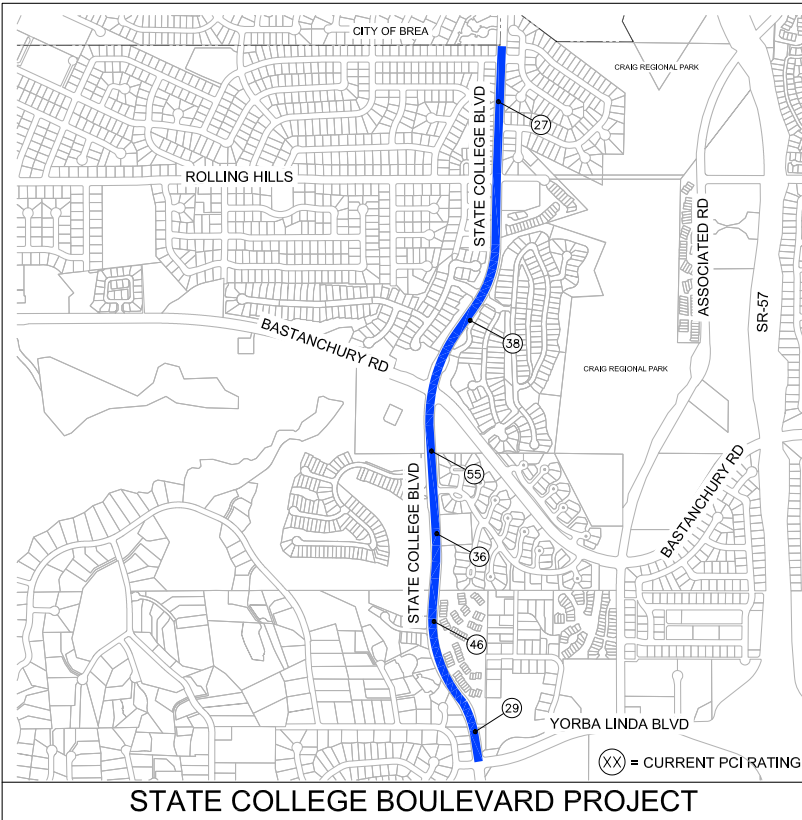
State College Repairs (this project was already approved. Funding would be supplemental)
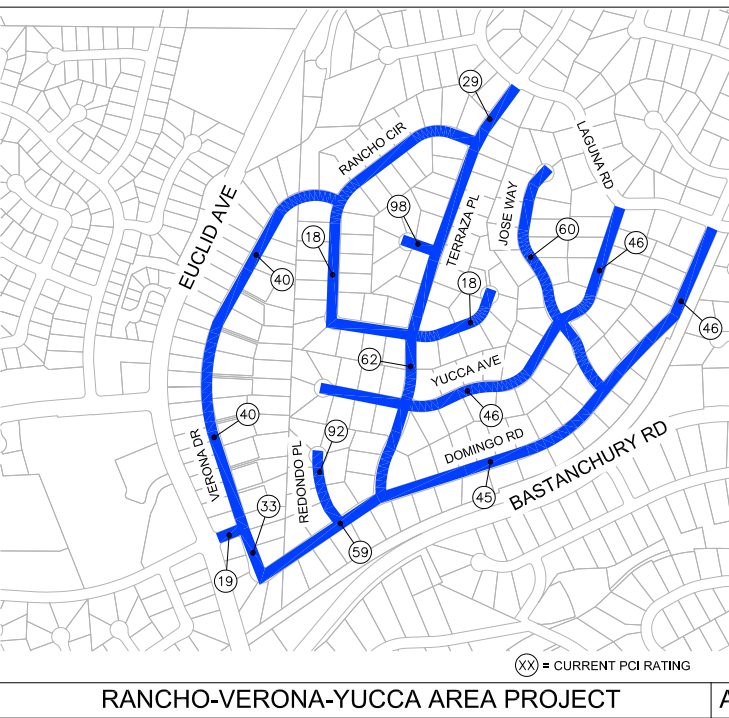
Rancho-Verona-Yucca Rehab
15. Street Rehab Plan
What This Is: This item is a plan for street repairs for the upcoming fiscal year. This is not a vote on any specific projects, but rather a vote on whether the plan is the correct approach.
Deeper Dive: The city has ~$12.6 million to spend on roads. Here’s where that money comes from, along with the recent, current, and planned street projects:
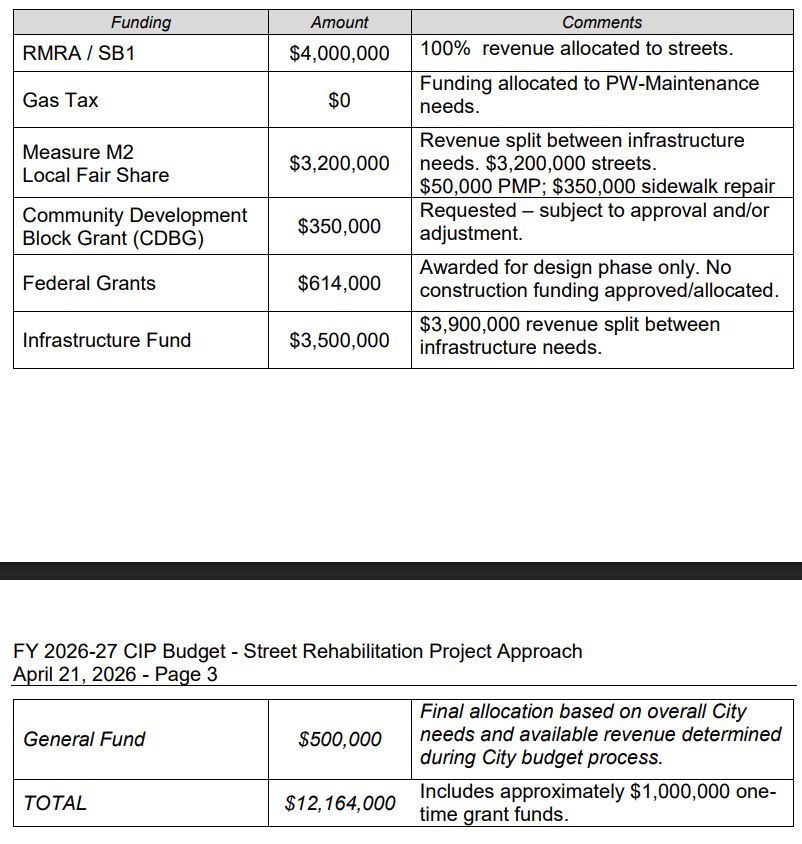
SB 1 is the gas tax increase. Measure M2 is a county sales tax to fund transportation. CDBG is the fund for low-moderate income community improvements.
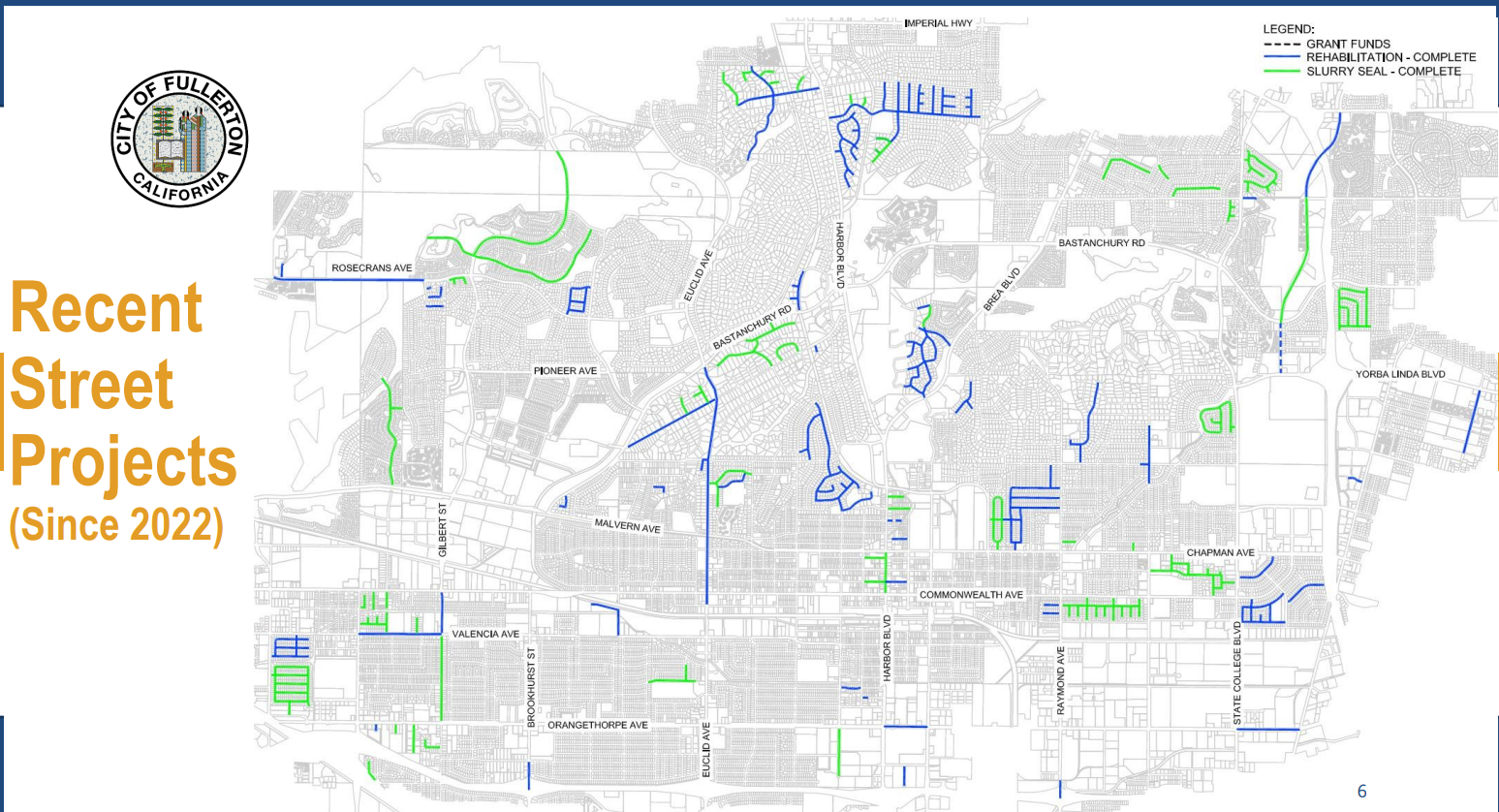
Recent street projects
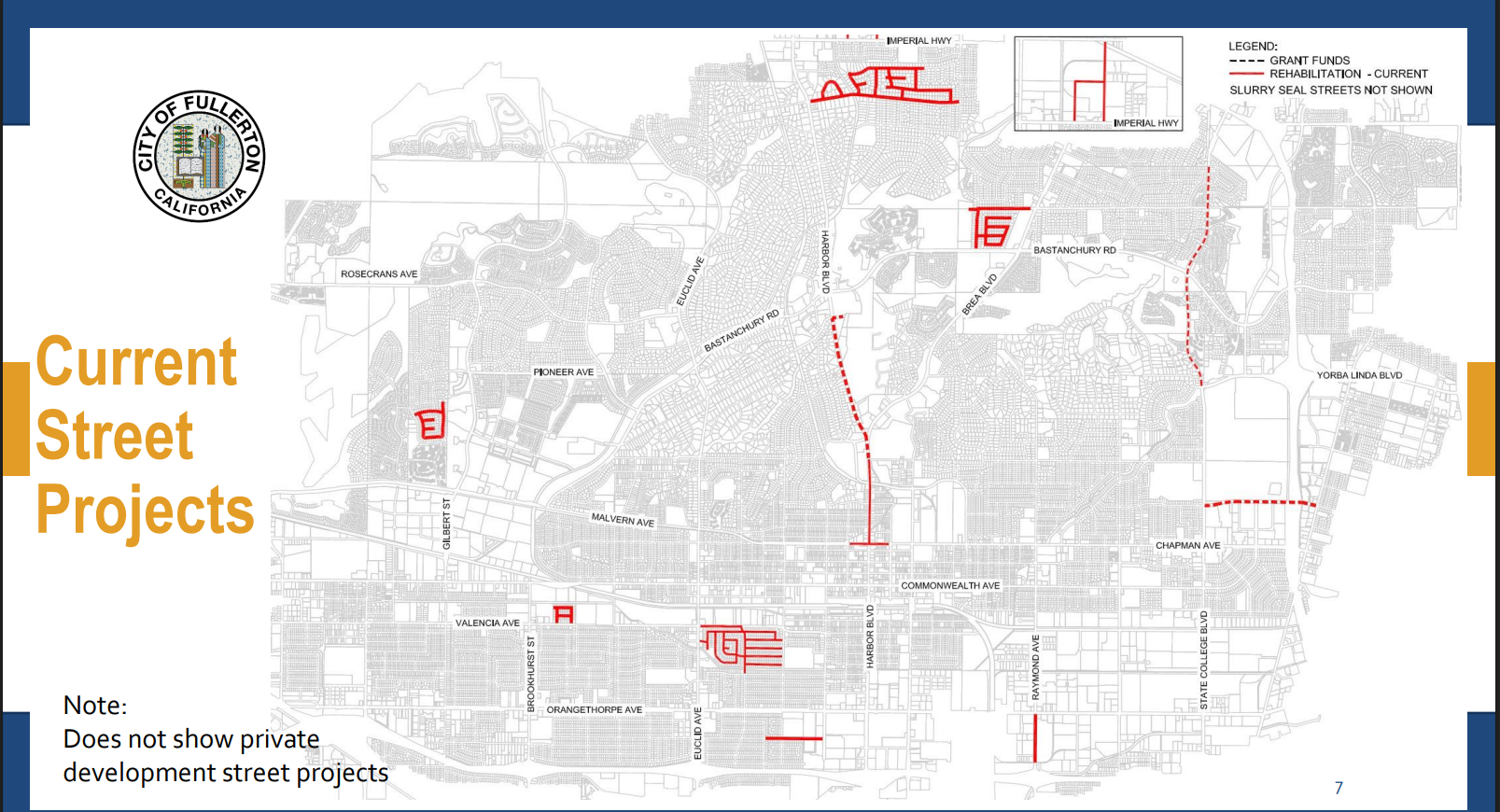
Current street projects
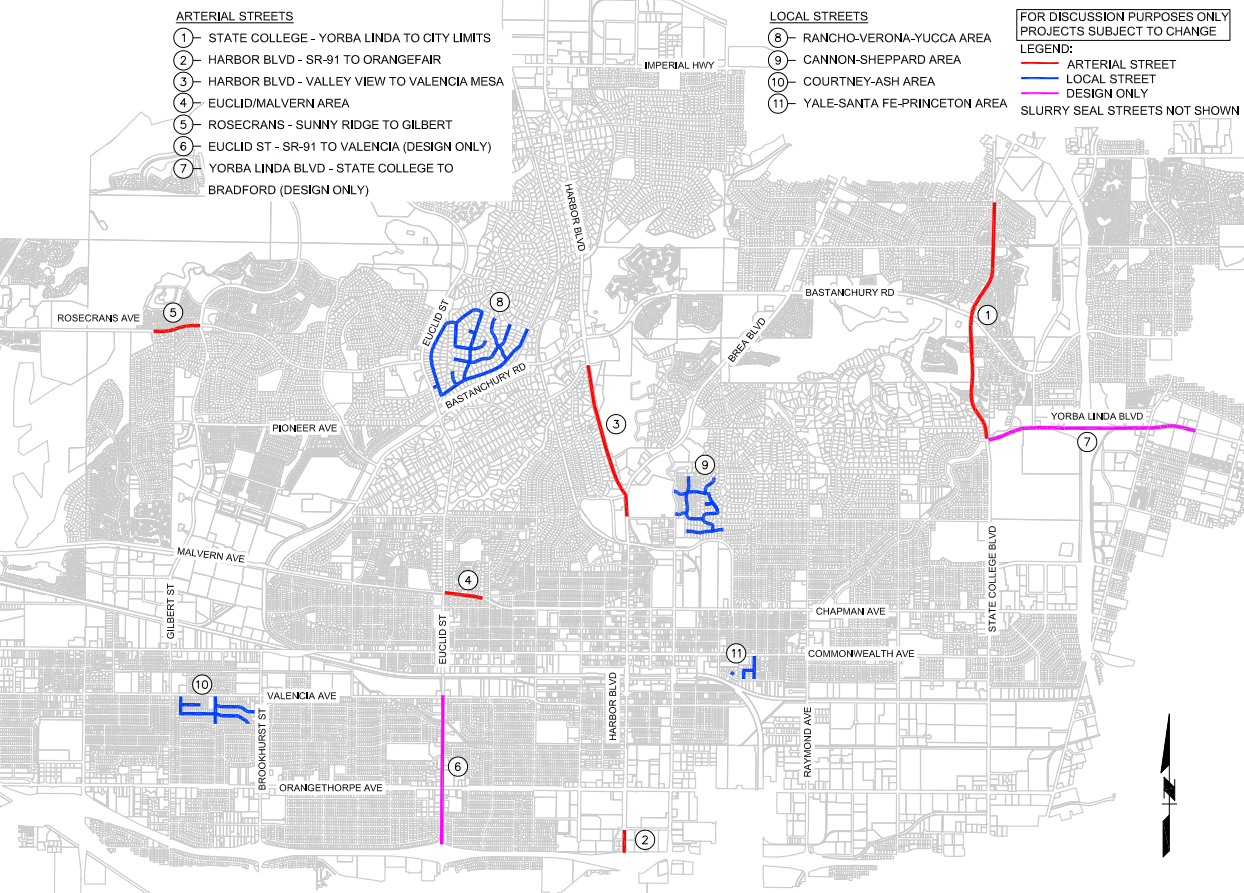
Planned street projects
16. Kratom Regulations
What This Is: The city is proposing a new law restricting the sale and distribution of kratom products in Fullerton. This is not a full ban, but it’s a regulated restriction. Staff is seeking approval of the regulations.
Deeper Dive: Kratom is a tree whose leaves can be used similarly to a stimulant or opioid depending on the dosage. This ordinance would prohibit sales of kratom: to people under 21, products with greater than 2% of the most harmful substance (7-hydroxymitragynine), and products with packaging that appeals to children.
Penalties could result in a misdemeanor, up to $1,000 fine, and/or 6 months in jail.
Recap: 4/14/26 Special City Council Meeting
City Council voted to proceed with all 6 waste haulers currently in contention for the contract. EDCO, CR&R, Universal, Athens, Valley Vista, and Republic will have an opportunity to revise their proposals
Explanations of the items being discussed can be found in the meeting preview.
Meeting Summary
City Council voted to proceed with all 6 waste haulers currently in contention for the contract. EDCO, CR&R, Universal, Athens, Valley Vista, and Republic will have an opportunity to revise their proposals
Public Comments
Mayor Jung began the meeting by requesting public comments on the item. Valley Vista’s CEO, David Perez, asked for another opportunity to make a proposal. Jeff Otter, Craig Park East HOA, spoke about how the rates will impact HOAs. An associate of CR&R highlighted key benefits within their proposal. One resident spoke on their support for unlimited bulk pickups. Myself and Andrew Rey spoke on the potential conflict of interest with Valley Vista Services, given that they have made a contribution of $15,000 to a local PAC that has spent heavily in recent races.
Council Discussion
Councilmember Charles asked the City Attorney whether the alleged conflict of interest would require recusals. The attorney stated that, under the Levine Act, direct contributions to campaigns within a year require recusals. Donations to PACs do not. Charles expressed support for union labor, stating it fits the ethos of the city. She said, since the companies were given the opportunity to revise their offers and the scoring appeared fair, she would support narrowing the list to the top 3 (EDCO, CR&R, Universal) plus the incumbent (Republic).
Councilmember Zahra asked staff whether the companies being considered have experience serving cities of Fullerton’s size or larger. Staff did not have that information readily available. Zahra expressed concerns with potential disruptions to service and negative impacts to the local workforce when switching haulers. He stated his support for a unionized company given their ability to carry over the existing workforce. Lastly, he stated that he wants to allow the incumbent, Republic Services, an opportunity to provide a counter offer. He spoke on their unlimited bulk pickup policy, extensive experience with large cities, and the importance of minimizing disruptions to services. He supported narrowing the list to EDCO, CR&R, and Republic Services.
Councilmember Valencia asked what the ranking would be if staff took rates out of the calculation. Staff said that the rates factor in about 20% of the total score, so removing that criteria would significantly change the rankings. They stated Athens would be one of the top haulers in this scenario given that they scored very high in multiple categories while scoring very low in rates.
Mayor Pro Tem Dunlap spoke about how he has concerns with particulars about how commercial and residential services differ. He said his priority is pricing. Dunlap expressed support for narrowing the list and providing the incumbent, Republic Services, an opportunity to counteroffer.
Mayor Jung asked what the ranking would be when only considering pricing. Staff stated the ranking of the top 3 in pricing would be NASA (no longer in contention), Universal, then Valley Vista. Mayor Jung made the motion to allow all 6 companies to remain in contention, with an opportunity to revise their offers. Staff asked for clearer direction given that these were comprehensive and revised offers. Jung didn’t provide clarification.
Jung Ends Meeting Without Taking A Vote
Following the back and forth with staff, Mayor Jung adjourned the meeting despite not taking a vote on the item. Councilmember Charles, who was participating through zoom, logged off. The City Attorney told Jung that they need to call for a vote, which Jung then did. The vote to proceed with all 6 companies was passed 3-1 (Zahra opposed). Charles was not present due to the confusion with the adjournment.
Preview: 4/14/26 Special City council meeting
This meeting was scheduled to decide which company will become Fullerton’s trash hauler.
Meeting Summary
This meeting was scheduled to decide which company will become Fullerton’s trash hauler.
Study Session: Waste Management Proposal
Fullerton’s waste management is currently serviced by Republic Services until 6/30/27. On 9/2/26, City Council directed staff to begin receiving proposals from waste management companies. They voted on a scoring chart that assigns point totals to different categories in order to evaluate all the offers consistently and fairly. Staff is now requesting City Council vote on which company to proceed with.
An important component of this process is SB1383 compliance. SB1383 is a state law passed in 2016 that governs how companies dispose of organic material. Noncompliance with this law can result in penalties of $500-$10k per violation per day.
The Rankings With Staff Summaries
EDco Disposal
Advantages: top three in SB 1383 Compliance, Related
Experience, Safety and Customer Service, Operation, and Value
Added Services. Top scores for Document Organization, Project
Team, Other Resources, and Local Commitment. Proposing
local Terminal to house fleet and customer service in the City,
generating City revenue through property taxes, sales tax, and
potential employment opportunities for residents
Disadvantages: No negatives in any scoring category. Would
charge $1.25 per household per month if they took over
Residential billing, this would reduce their proposed rate score,
dropping them from the top spot, if City chooses hauler billing
CR&R Environmental Services
Advantages: Due to number and type of facilities, number of
franchises in Orange County and program data presented in the
proposal, CR&R scored highest in SB 1383 Compliance and second
highest in Related Experience. Received highest score for Value
Added Services, providing full SB 1383 procurement offset and
additional quantified notations totaling $800,000. Highest
interview score. Provided only lower cost landfill option.
Disadvantages: Upload challenges due to large file size resulted insubmission of complete draft without artwork, and therefore
scored lowest in the Document Organization category. Neglected
to provide performance metric and missing table and formatting
issues in the Safety and Customer Service area of the proposal.
Universal Waste Systems
Advantages: Second-highest in Project Team and Resumes, Value
Added Services, and Local Commitment. Highest ranked in
Proposed Rates. Ownership of multiple regional disposal
processing facilities, along with a solid waste truck and container
manufacturing company, provides an operational advantage.
Disadvantages: Minimal experience with serving a citycomparable to Fullerton, and rolling out a large scale commercial
organics program.
NASA Services
Advantages: Scored well in most categories, and received the
highest mark for Proposed Rates and References.
Disadvantages: Size of firm and limited number of exclusivemunicipal franchises. Minimal Safety and Customer Service
information submitted in proposal, and not as detailed as other
proposers. Limited Value Added Services provided received
lowest score.
ATHENS SERVICES
Advantages: They scored highest in Related Experience, and
Safety and Customer Service. Other than pricing, one of the
highest rated firms.
Disadvantages: More exceptions to the agreement than mostproposers, and their pricing was significantly higher.
Valley Vista Services
Advantages: Interviewed very well, and presented the largest
discount in pricing in their resubmittal to address actual County
Landfill rates for July 2027. Very good scores on 9 out of 15
categories including third highest scoring on price.
Disadvantages: Some reviewers felt the proposal was notorganized well and noted missing attachments. Referenced letter
from insurance company was not attached which also impacted
financial ability to perform scores by a number of evaluators.
Concerns over compliance order in Pasadena, insufficient SB 1383
compliance detail, and limited examples of educational materials
in comparison to other proposers. Safety and Customer Service
marked down for generalized response. Dollar value provided for
enhancements was below average.
GreenWaste Recovery
Advantages: Excellent references and operations in Northern
California. One of the best organized proposals. Great local
commitment. Fullerton would be their base of operations for
planned expansion into Southern California.
Disadvantages: No local operational experience or facilities.Number of Exceptions taken to City's agreement contributed in
second-lowest score. Proposed Value Added Services did not
provide the tangible benefits of other proposers. Pricing was
among the highest.
Ware Disposal
Advantages: Document Organization, SB 1383 Compliance,
Financial Ability to Perform, and Operation scoring was good.
Disadvantages: No area in the reviews resulted in a top threescore, and only one in the top four. Lack of experience with an
exclusive franchise on par with Fullerton. Indicated letter of
commitment for organic processing not relevant to Fullerton.
Insufficient illustration of safety operations and training records.
Some apprehension with the customer service program not being
as robust and localized as other firms presented. Lowest score in
Oral Evaluation, not being as prepared or organized as other
proposers.
Republic Services
Advantages: Document Organization, Financial Ability to Perform,
and Guaranteed Organic Waste Capacity scores were above
average.
Disadvantages: Received lowest score for SB 1383 Compliance,
Operation, and References. In general, the reviewers were
concerned with the lack of acknowledgement of current contract
compliance, operational, and customer service issues. They also
received the lowest score in Exceptions, objecting to the City's
preferred CPI and age of fleet requirements. Proposed
Commercial rates were among the highest
How Do Their Services Differ?
Below shows how each company differs in general costs or services. Bid alternate refers to the increase in cost (if any) if the company bills residents directly as opposed to the city handling billing. Pricing is montly.
EDCO
Residential: $32.75
Commercial: $236.82 (up to 3 cubic yards. one pickup per week)
Bid Alternate: $1.25
Bulk Item Pickup: 4 free per year
CR&R Environmental Services
Residential: $32.64
Commercial: $275.67 (up to 3 cubic yards. one pickup per week)
Bid Alternate: $0
Bulk Item Pickup: 4 free per year
Universal Waste Systems
Residential: $20.69
Commercial: $261.98 (up to 3 cubic yards. one pickup per week)
Bid Alternate: $1.45 per customer per household per month
Bulk Item Pickup: 4 free per year
NASA Services
Residential: $26.00
Commercial: $206.00 (up to 3 cubic yards. one pickup per week)
Bid Alternate: $120,000 per year per household
Bulk Item Pickup: 4 free per year
Athens
Residential: $42.32
Commercial: $318.37 (one bin. one pickup per week)
Bid Alternate: $0
Bulk Item Pickup: 4 free per year
Valley Vista Services
Residential: $29.24
Commercial: $242.10 (up to 3 cubic yards. one pickup per week)
Bid Alternate: $0.53 per customer per household per month
Bulk Item Pickup: 4 free per year. $40 after that + $20 per item
GreenWaste Recovery
Residential: $34.94
Commercial: $312 (up to 3 cubic yards. one pickup per week)
Bid Alternate: $0
Ware Disposal
Residential: $37.73
Commercial: $311.74 (up to 3 cubic yards. one pickup per week)
Bid Alternate: $1.55 per customer per household per month
Bulk Item Pickup: 4 free per year
Republic Services
Residential: $25.82
Commercial: $351.96 (up to 3 cubic yards. one pickup per week)
Bid Alternate: $0
Bulk Item Pickup: Unlimited (by request)
How Did Each Company Score?

Waste management scores by category
Policy Perspective
Waste management contracts are one of the most expensive and longest contracts that cities enter into. It is important that the decision is not made lightly. Up for consideration are the top three (EDCO, CR&R, and Universal) as well as three companies requested by Jung and Valencia: Athens (5), Valley Vista (6), and Republic (9).
The Top 3
EDCO ranks highest because they have competitive pricing, a proven track record, quality customer service, and excellent organization and compliance. Their local terminal would also provide jobs and additional revenue to the city. They are the strongest choice overall and would be the safest option for the City.
CR&R ranks second mostly due to excellent compliance, experience, facilities, and extra services. This option is the best compliance-heavy proposal, providing strong legal protection and infrastructure.
Universal ranks largely due to their rates, customer service, and extra services. This option would be the best “value” proposal, providing the best rates while still scoring high in operations. The main concern with this option is their lack of experience with cities Fullerton’s size or larger.
Other Considerations
Athens is a very large company with extensive experience servicing large cities. They have excellent compliance with state law and quality customer service. However, they rank last in pricing due to rates significantly higher than the other proposals.
Valley Vista offers competitive pricing but ranks very low in compliance, financial capability, organization, and customer service. Given that Universal offers better rates with better services, Valley Vista is a weak choice with no distinctive benefits.
Republic ranks high in financial capability but very low in most other categories. They are arguably the weakest option on this list.
Recap: 4/7/26 City Council Meeting
City Council denied the signal light at the Valley View x Euclid intersection (3-2, Zahra & Charles opposed), approved increasing the cannabis enforcement penalties (unanimous), and approved the IT contract (unanimous)
Explanations of the items being discussed can be found in the meeting preview.
Meeting Summary
City Council denied the signal light at the Valley View x Euclid intersection (3-2, Zahra & Charles opposed), approved increasing the cannabis enforcement penalties (unanimous), and approved the IT contract (unanimous)
Explanations of the items being discussed can be found in the meeting preview.
Agenda Order Changed
A large crowd attended the meeting regarding the signal light. Jung stated that he will be moving public comment to the end of the meeting in order to get to the signal light as soon as possible. Dunlap expressed support. Charles objected, stating there are people who want to speak but aren’t here yet as they assumed the agenda order would remain unchanged. Jung replied “your objection is noted”. Charles made the motion, seconded by Zahra, to overrule Jung and allow the agenda to remain unchanged. Motion failed 2-3 (Jung, Dunlap, Valencia opposed).
A couple of residents messaged me sharing that they were unable to speak on the item due to this change. They also shared that they were having issues with joining Zoom and were in communication with the clerk’s office who confirmed they were having issues.
Signal Light
Prior to public comment, it was disclosed that Jung inadvertently selected “Reply All” to an email to the City Council in which he expressed his position on the item. Under California law, City Councilmembers may not discuss how they will vote on an item with a majority of councilmembers. The City Attorney stated that because Jung immediately notified him of the issue and stated it was inadvertent, it is not necessary for him to recuse himself on this item.
Public comment included many residents who lived in the area that this light would be installed. Most speakers spoke in opposition to the project, with a few speaking in support. The opposition expressed concerns about vehicles cutting through their neighborhood and increased traffic congestion. Those in support spoke on the safety issues at this intersection, the City’s legal liability should a collision occur, and the poor visibility given the slope of the road.
Jung opened the discussion by stating that he believes the solution is increased enforcement of speeding in the area and will be voting no.
Zahra stated that he thinks the majority will vote to deny this, and if that is the case, that they direct staff to explore other options to improve the safety at this intersection.
Charles asked the City’s traffic engineer what they have done so far to address the safety concerns: widened the lanes, changed the angle of turns, improved the signage, and installed speed signs. These have not resolved the safety issue. Charles said that signal lights are used to control dangerous traffic, and that speed humps can be used to limit cut-through traffic in the surrounding neighborhoods. She said she doesn’t like to go against public opinion, but that this is a safety issue that she thinks they need to take seriously.
Dunlap stated that the problem with this intersection is Euclid, not Valley View. He said that they sent this item back to the Transportation Commission to address resident concerns yet the item returned back to them unchanged. Dunlap closed by saying that the signal light would increase traffic and that the “common sense impact” is bad.
Valencia said that she appreciates people coming out and speaking and will be voting no.
Zahra requested that in the denial that they give staff specific instructions as to how to solve the safety issue. Jung, Dunlap, and Valencia said that staff understands what they need to do. Charles pushed back saying that the traffic engineer made it clear that they have tried many different options already. The City Manager joined the discussion to confirm that staff has tried many measures and so he can’t guarantee that staff will come back with a solution.
City Council voted to deny the signal light installation 3-2 (Charles & Zahra opposed)
Cannabis Enforcement
Jung stated that there are bad actors who see the current penalties as simply a cost of doing business. He agrees with streamlining enforcement and increasing penalties, moving to approve this item with Zahra seconding.
Zahra stated that this is helpful for enforcement in the short term, but that this is not the long term solution. He said that there is a market for cannabis in the city, and it is not difficult for people to obtain it. So, the city’s current policy has been ineffective and a cost to the city. The long term solution would be to bring those consumers into regulated shops that will be safer and offer the city some control. He also spoke about how this could generate revenue for the city, as opposed to being a financial burden.
Charles asked what the legal dispensaries in Costa Mesa, a city that implemented a similar policy, thought about this current policy. Staff shared that legal dispensaries generally like the increased enforcement as it helps consumers choose the regulated shops over the illegal dispensaries.
Item approved 5-0
IT Contract
City Council had questions on the details of the contract, the company’s history, and potential impacts to service levels. Council found no major concerns.
Item approved 5-0
Public Comment
Multiple public commenters spoke on tobacco shops violating current laws, particularly in selling flavored e-cigarettes, selling to minors, and selling illicit drugs.
One commenter spoke on construction tax fraud, that is, the paying of contractors under the table to evade taxes. He continued by saying that these practices hurt workers, but also hurt companies who are following the law as they have to compete with others who are breaking the rules. Lastly, these practices hurt the city as they don’t receive the taxable revenue that could be used to support city services. At least two dozen tradespeople in orange vests were in attendance, with a handful holding signs supporting the commenter’s statement.
One commenter spoke on Dunlap’s behavior last meeting, saying that it violated policy by creating a hostile work environment. Another commenter expressed concerns about residential construction in their neighborhood, which is a preservation district. The next commenter spoke on the City sending him a cease-and-desist letter (see most recent video). Other topics discussed: the decision to move public comment to the end of the meeting, ongoing efforts to recover the remains of fallen soldiers, the parks master plan, the budget error, updating the City’s municipal code, and the actions of ICE.
Council Reports
The Housing Director shared that the construction in the preservation district can only be regulated by objective standards, so there are certain features that they can’t control, particularly the windows.
The City Manager stated that they are in the process of contacting vendors to perform a forensic audit on the budget error.
Zahra expressed support for an investigation into the budget error to rebuild trust with the community. He said he hopes it will come back soon and that it is presented a transparent manner. He disagreed with the decision to send a cease-and-desist. He then asked to agendize a local tobacco license program to regulate the industry within the city, requesting it return within 45 days. Charles seconded.
Charles spoke about her office hours, ICE’s actions, recent events she’s attended, and asked residents to consider signing up for her newsletter.
Valencia spoke on recent events she’s attended.
Dunlap spoke about the budget issue, requesting that the staff bring back an item to expand the Fiscal Sustainability Ad Hoc Committee and exploring cuts/privatization of services.
Preview: 4/7/26 City council meeting
This meeting includes a proposed traffic signal installation, changes to cannabis enforcement policy, and several infrastructure projects
Meeting Summary
This meeting includes a proposed traffic signal installation, changes to cannabis enforcement policy, and several infrastructure projects
Consent calendar (Items 1-10)
The consent calendar are typically routine items that are passed in bulk by the City Council. Any item can be pulled from the consent calendar by a single City Councilmember for a separate vote and/or discussion
March 17, 2026 meeting minutes
The minutes of the prior City Council meeting. This documents the events that took place in writing
classification plan update
This renames the “Secretary” → “Administrative Aide” to better align with modern standards
loan consolidation agreement for east fullerton villas
This restructures a loan from 1994 on an affordable housing project so the City can actually receive steady payments instead of almost nothing
us army corp of engineers utility easement renewals
The City is renewing easements for sewer and drain infrastructure. If they don’t, they’d have to remove critical infrastructure which would be costly
additional microsoft renewal licenses emergency purchase
The City had to spend an additional ~$40k on Microsoft licenses after underestimating what was needed to keep critical systems running. This asks for retroactive approval (emergencies/time-sensitive needs allow this)
critical network infrastructure equipment purchase
The City spent ~$109k to replace failing network equipment at fire stations to avoid disruptions to emergency response systems. This asks for retroactive approval
purchase order for solar powered streetlights
The City plans to spend up to $100k per year to gradually replace unreliable streetlights with solar-powered ones
palm street area street rehabilitation
The City is approving a $2 million street repair project, partially funded by neighboring cities, to fix severely deteriorated roads.
baker avenue rehabilitation
The City is approving a ~$533k project to repair a deteriorated street near a school, including sidewalks and accessibility upgrades
coronado area water main replacement
The City is replacing aging water pipes that have a history of breaking as part of a broader plan to upgrade water infrastructure
regular business (items 11 through 13)
11. Euclid and Valley view signal light
Problem: Residents in the area expressed concerns with high speeds in the area and frequent crashes. Staff conducted studies and tried various solutions, yet the traffic conditions remain mostly unchanged
Proposed Solution: Staff recommends that City Council install a signal light at this intersection to improve safety and reduce the City’s liability
Why This Matters: Impacts public safety of pedestrians, cyclists, and drivers
Policy Perspective: Staff has exhausted all reasonable alternatives to improve safety at this intersection short of a signal light. It is of the utmost importance that the City implement the infrastructure necessary to keep residents safe, and as it stands, there are no alternatives to do so. This signal light would protect pedestrians, cyclists, and drivers, while having minimal impact on the nearby neighborhoods.
12. Cannabis fines and penalties
Problem: Fullerton does not allow dispensaries within the city. The current enforcement process is costly, time-consuming, requires coordination between multiple departments, and has been ineffective in permanently shutting down these dispensaries.
Proposed Solution: Staff recommends the City strengthen enforcement using recently passed state laws that allow costlier fines and more tools for enforcement.
Why This Matters: Costs the City money, affects local businesses and landlords, and impacts public safety.
Policy Perspective: Fullerton is a college town, and thus, likely has a relatively larger market for cannabis compared to other cities. Even with these stronger enforcement measures, the demand will still exist, and thus illegal dispensaries will be a persistent issue.
Rather than waste funds on legal costs and staff time, the City should pursue legalization of dispensaries to collect additional revenue and control a market that is currently operating without oversight. This would require a shift in policy direction and could not be immediately implemented at this meeting.
If the council wishes to proceed with their current policy direction, the recommended changes are superior to our current policies and will allow more costs to be recovered.
13. IT management and support services
Problem: The City contracted their IT services out to Glass Box Technology in 2020 following a cybersecurity incident. This agreement costs $3.6 million a year and expires in June 2026. Staff has identified another qualified firm who can provide similar services at a reduced cost
Proposed Solution: Enter into a contract with Infinity Technologies until June 2029, with two optional one-year extensions. This would cost ~$2 million, saving $1.6 million annually
Why This Matters: City operations rely on technology that need to be serviced by professionals. IT services are critical infrastructure to every city in this era
Policy Perspective: This is a qualified firm and can provide similar services at a reduced cost.