Grant Thornton’s Financial Review
Summary
In 2025, Fullerton presented a budget as balanced even though it relied on reserves and its ongoing expenses exceeded its revenues. Grant Thornton later criticized how the City’s financial condition was communicated. There is also an unresolved allegation that management had been warned beforehand.
Instead of commissioning an audit or forensic investigation designed to determine whether anyone knowingly misled the public, the City hired Grant Thornton Advisors for a limited advisory review. The agreement explicitly says it was neither an audit nor a fraud investigation.
The City then publicly rebranded that review as an “independent financial audit” and used it to announce that there had been no fraud or intentional misconduct.
Fullerton used a review that was not designed to investigate misconduct to publicly clear itself of misconduct.
Background
In early 2026, Fullerton disclosed major concerns involving its budget and financial reporting. These included:
an approximately $2.9 million prior-period accounting adjustment;
approximately $2.7 million in General Fund balance reclassifications;
questions about how prior budgets were presented as balanced;
concerns about the accuracy of the City’s five-year projections;
and a long-term structural budget deficit.
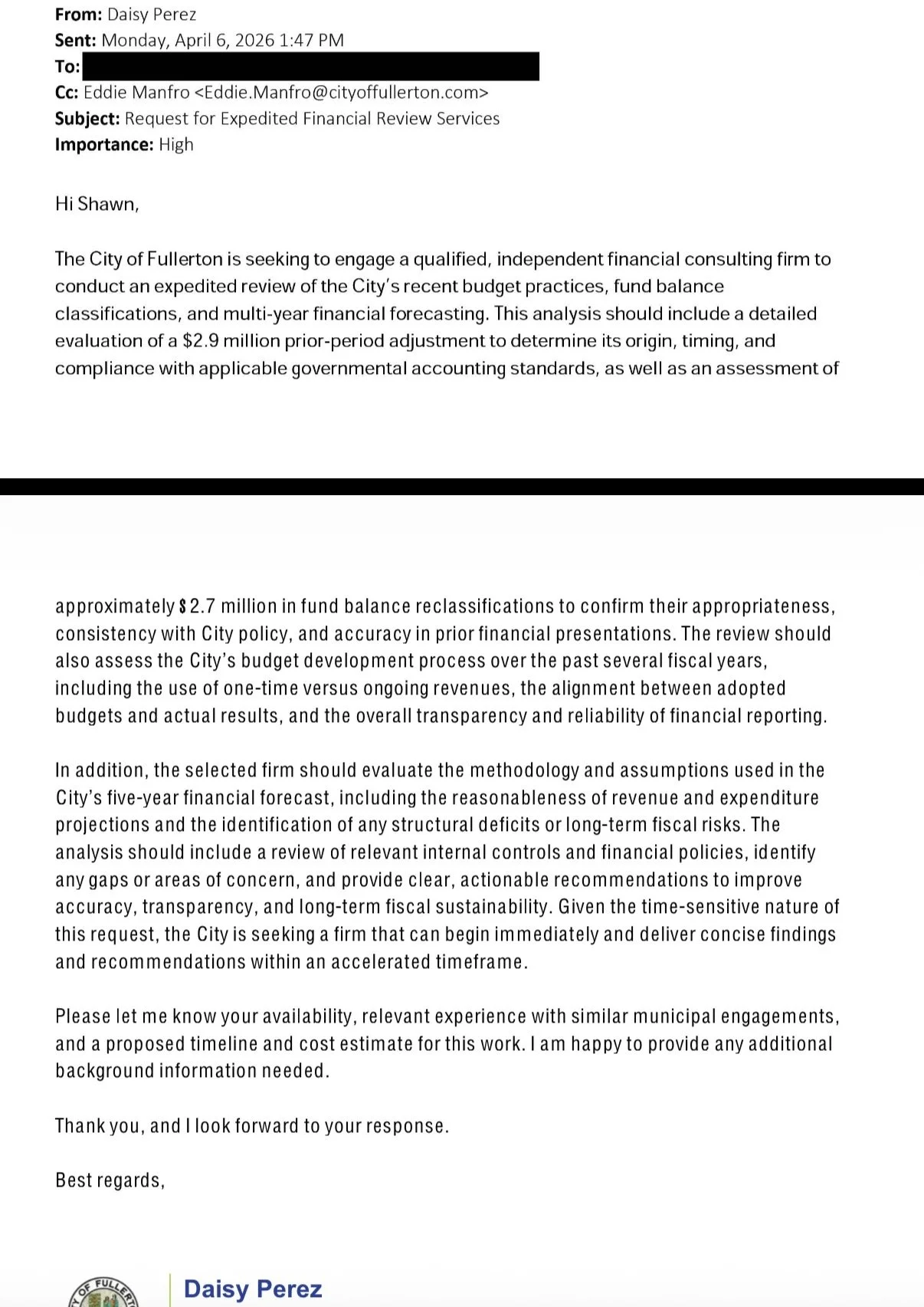
On April 6, Deputy City Manager Daisy Perez contacted outside firms seeking a “qualified, independent financial consulting firm” to conduct an “expedited review” of the City’s recent budgeting practices, fund-balance classifications, financial forecasts, internal controls, and financial reporting. Her request asked the selected firm to identify concerns and provide recommendations to improve transparency and long-term fiscal sustainability. It did not request an audit opinion, identify auditing standards, or ask for a formal fraud investigation.
The City entered into a Master Services Agreement with Grant Thornton Advisors LLC.
The agreement states that Grant Thornton Advisors was not being engaged to provide an attestation report or opinion concerning financial data or internal controls.
The agreement states:
“This engagement is not a financial statement audit or other form of attestation service.”
It also states:
“This engagement does not constitute a formal fraud or forensics investigation.”

Grant Thornton agreed to observe whether potential indicators of improper or fraudulent activity came to its attention during the procedures it performed. If such indicators were encountered, the firm could notify City leadership and recommend a separate forensic investigation.
This was not designed as an investigation to affirmatively determine whether fraud or intentional misconduct had occurred.
Interviews and internal political context
Grant Thornton scheduled interviews with department directors, managers, councilmembers, and other stakeholders. The agreement also authorized Grant Thornton to record interviews and other meetings for documentation purposes.
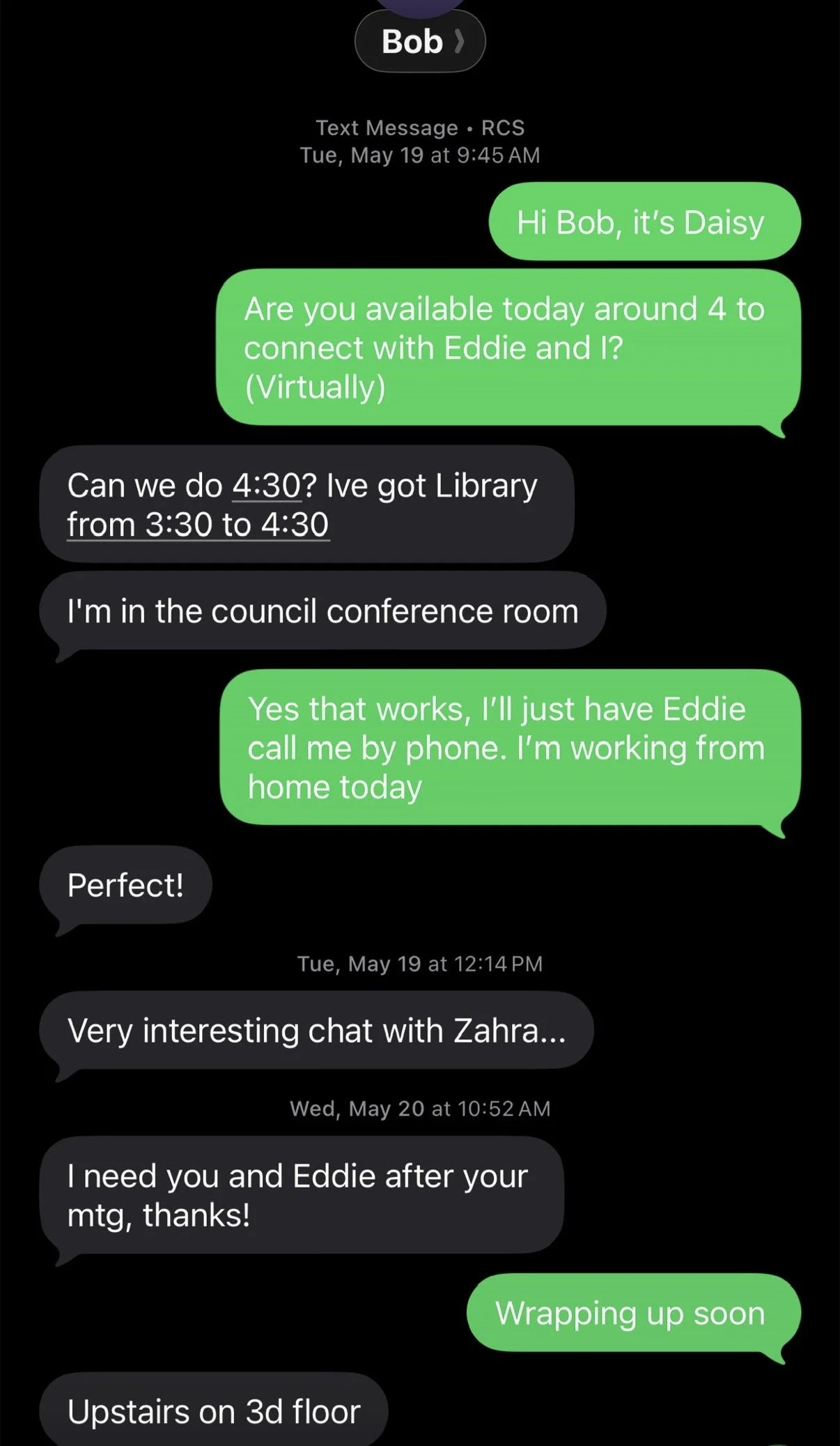
PRA-produced text messages show that Grant Thornton director Bob Hawkey described one councilmember interview as a:
“Very interesting chat with Zahra…”
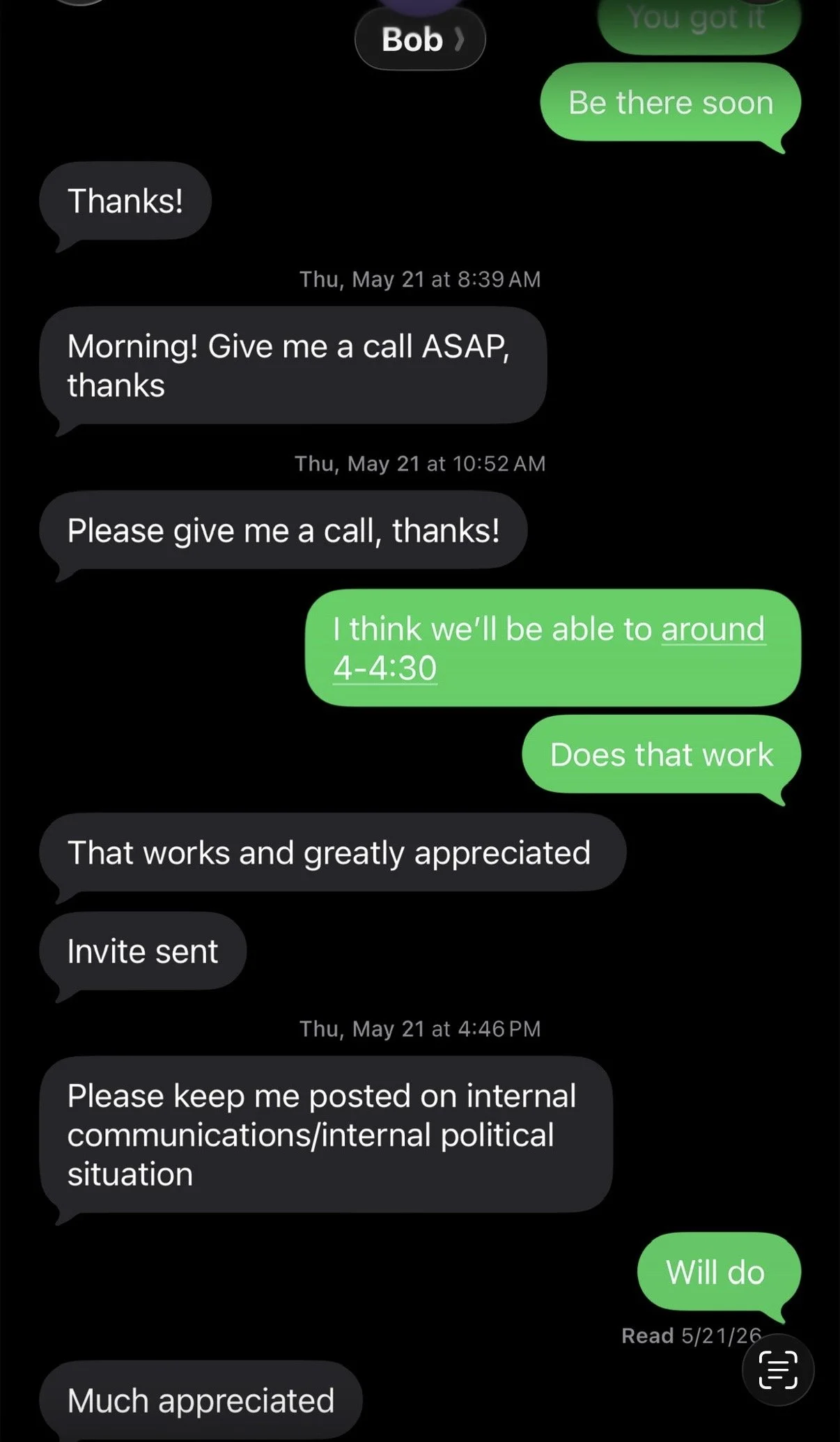
On May 21, Hawkey asked Deputy City Manager Daisy Perez:
“Please keep me posted on internal communications/internal political situation.”
Councilmember Zahra’s account
Councilmember Ahmad Zahra told Fullerton Transparency that, during his interview, he shared an account involving former City Manager Eric Levitt and Deputy City Manager Daisy Perez.
According to Zahra, Perez had told him on two separate occasions that she approached Levitt concerning the fact that the City’s budget was not balanced prior to the presentations that portrayed the budget as balanced.
Daisy Perez did not respond to requests for comment. Zahra states that both Interim Finance Director Steven Avalos and City Manager Eddie Manfro were witnesses to his conversations with Perez.
Public-relations and “adverse media” discussions
The May 26 email also shows that Grant Thornton became involved in discussions concerning public messaging.
Stewart introduced Manfro to a managing director in Grant Thornton’s Advisory Services Quality & Risk Group whose national role included assisting teams and clients facing difficulties involving “adverse media.”
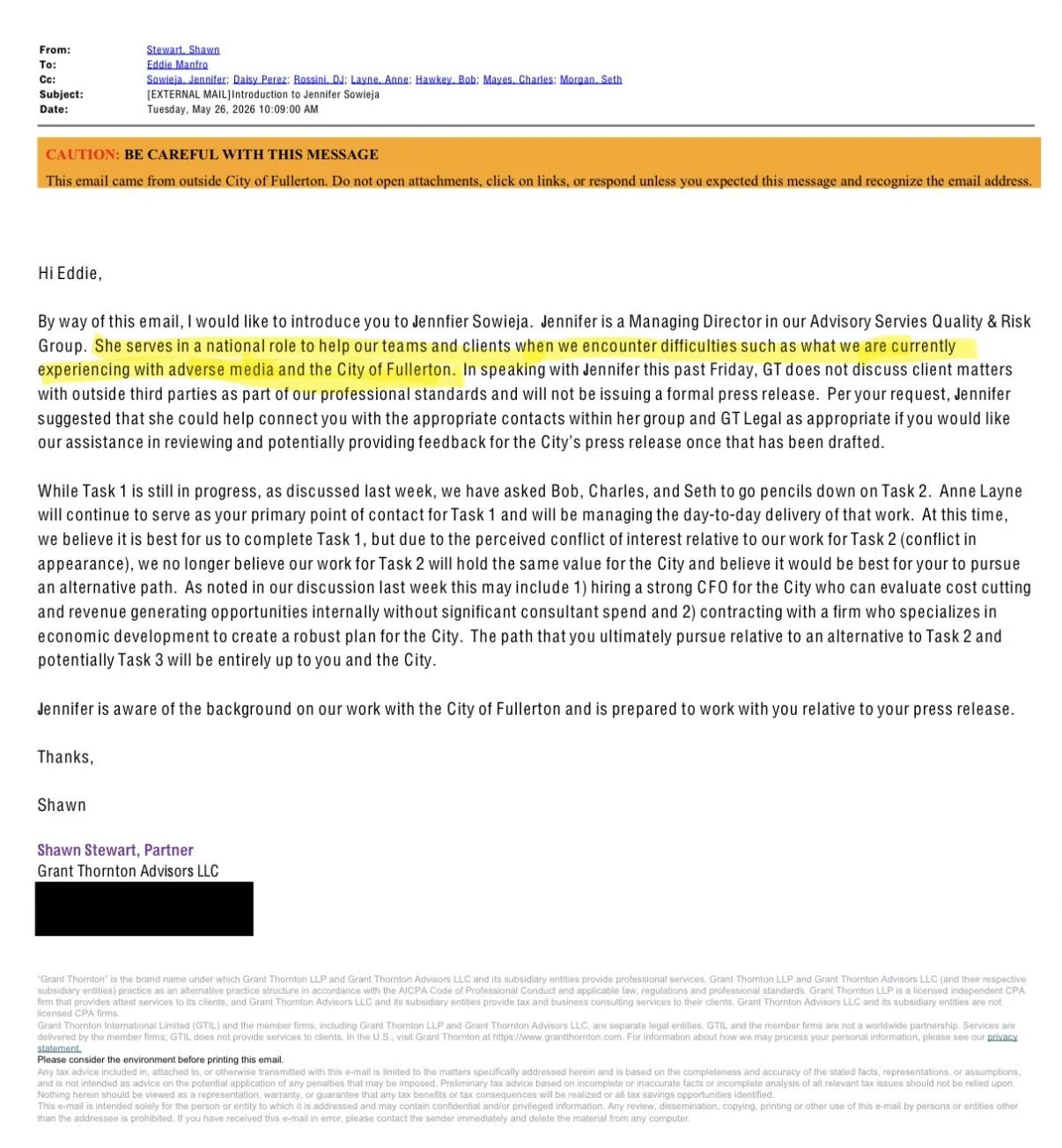
Stewart stated that Grant Thornton would not issue its own formal press release or discuss client matters with outside third parties. However, at the City’s request, Grant Thornton offered to connect the City with Quality & Risk personnel and Grant Thornton Legal to potentially review and provide feedback on the City’s press release.
It remains unclear:
whether Grant Thornton reviewed the final release or social-media carousel;
what edits or qualifications it recommended;
whether it approved the term “independent financial audit”;
and whether it approved the City’s fraud-related wording.
What the City told the public
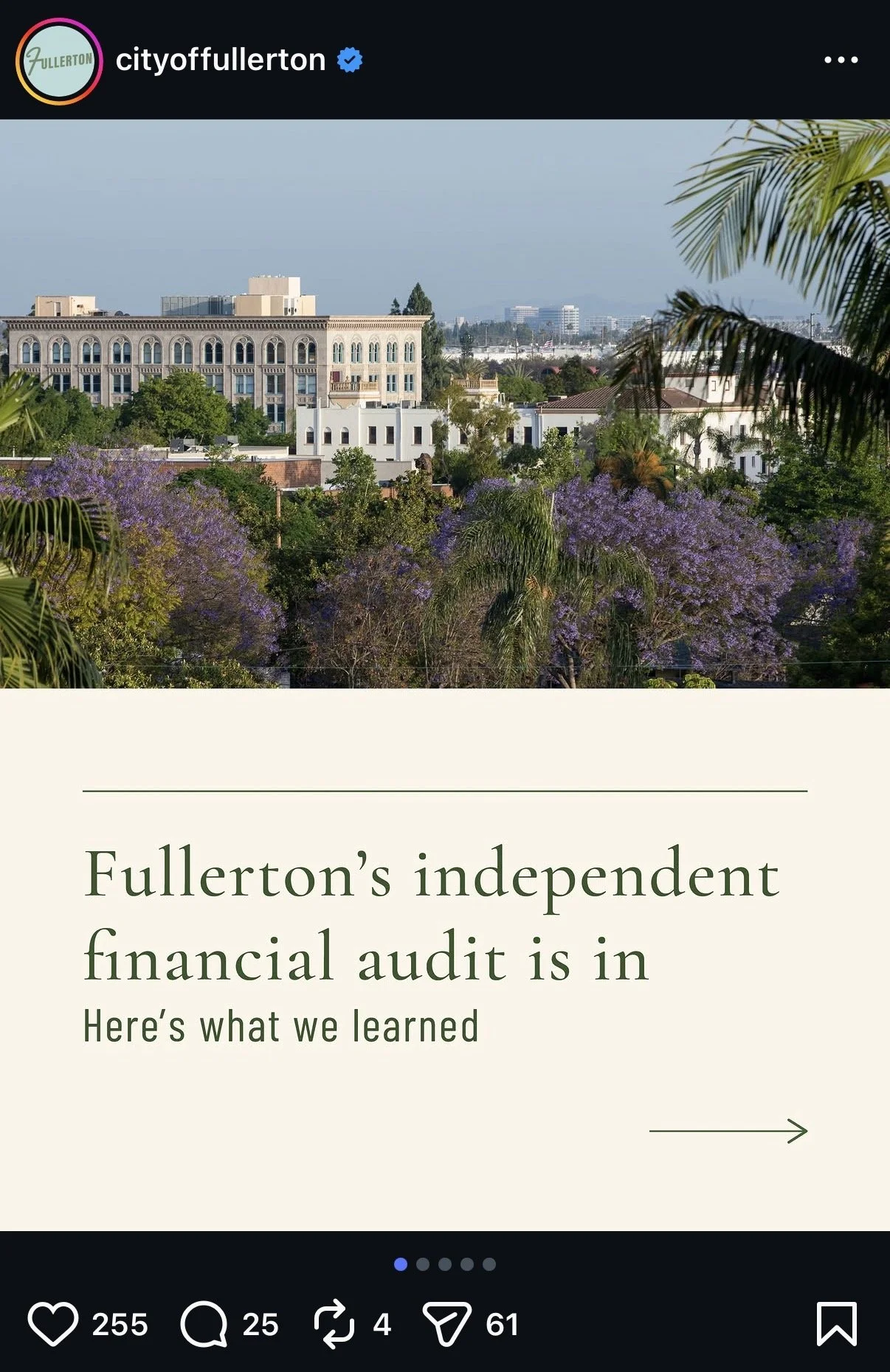
On June 18, the City published a social-media carousel announcing:
“Fullerton’s independent financial audit is in.”
Subsequent slides repeatedly described the work as an “audit” and highlighted the following as key findings:
“No indicators of fraud”
“No intentional misconduct”
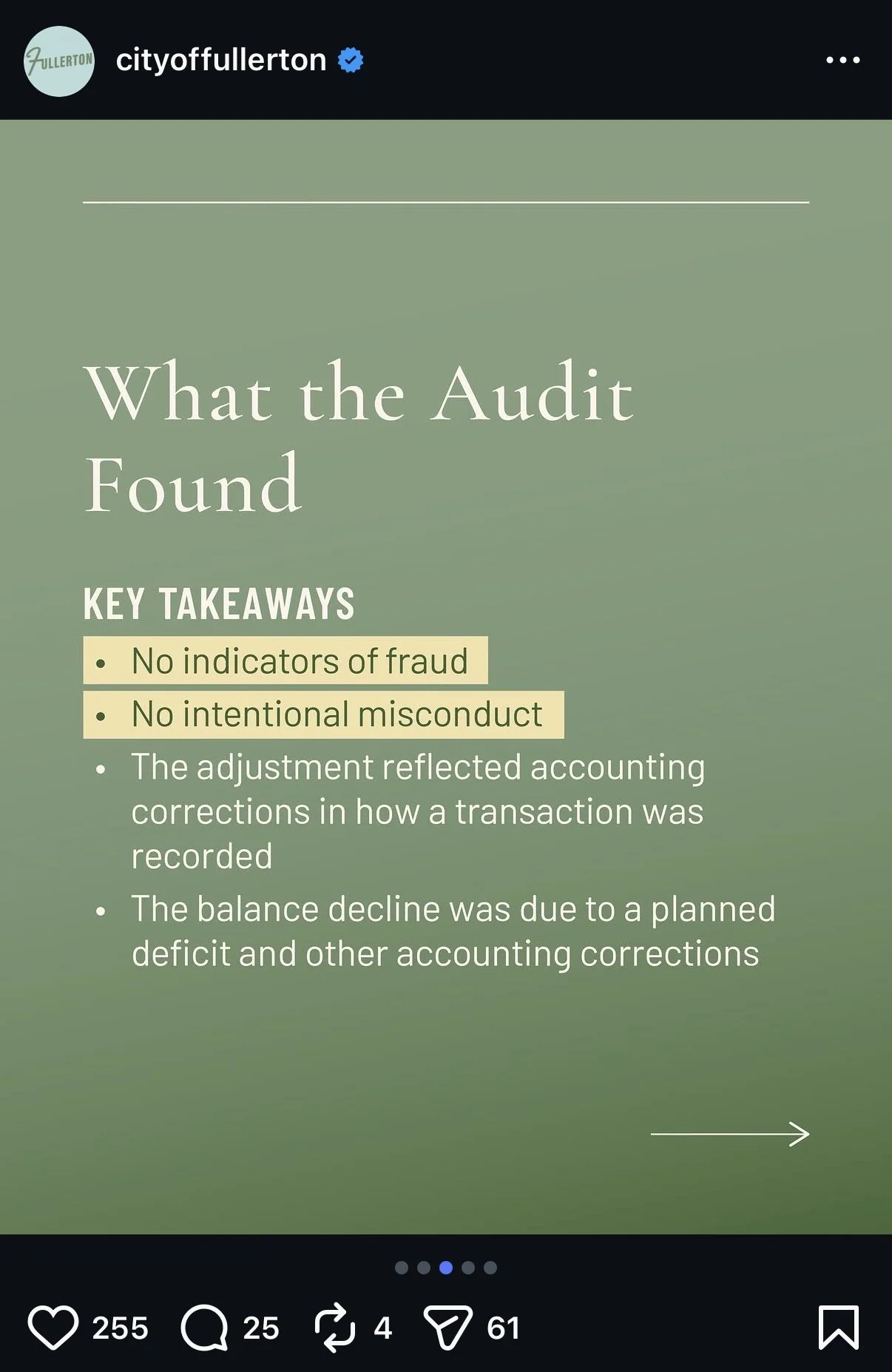
The post did not disclose that:
the City had contracted with Grant Thornton Advisors LLC rather than Grant Thornton’s licensed audit firm;
the agreement called the work advisory services;
the engagement was not a financial-statement audit or attestation service;
the engagement was not a formal fraud or forensic investigation;
The City could accurately have described the work as an independent financial and budgeting review, an outside advisory review, or an accounting and budgeting analysis.
Describing it as an “independent financial audit” created a substantially different public impression about the type of work performed and the level of assurance provided.
City Manager Response
City Manager Eddie Manfro explained that the City used the term “audit” in a general, everyday sense rather than its technical accounting meaning.
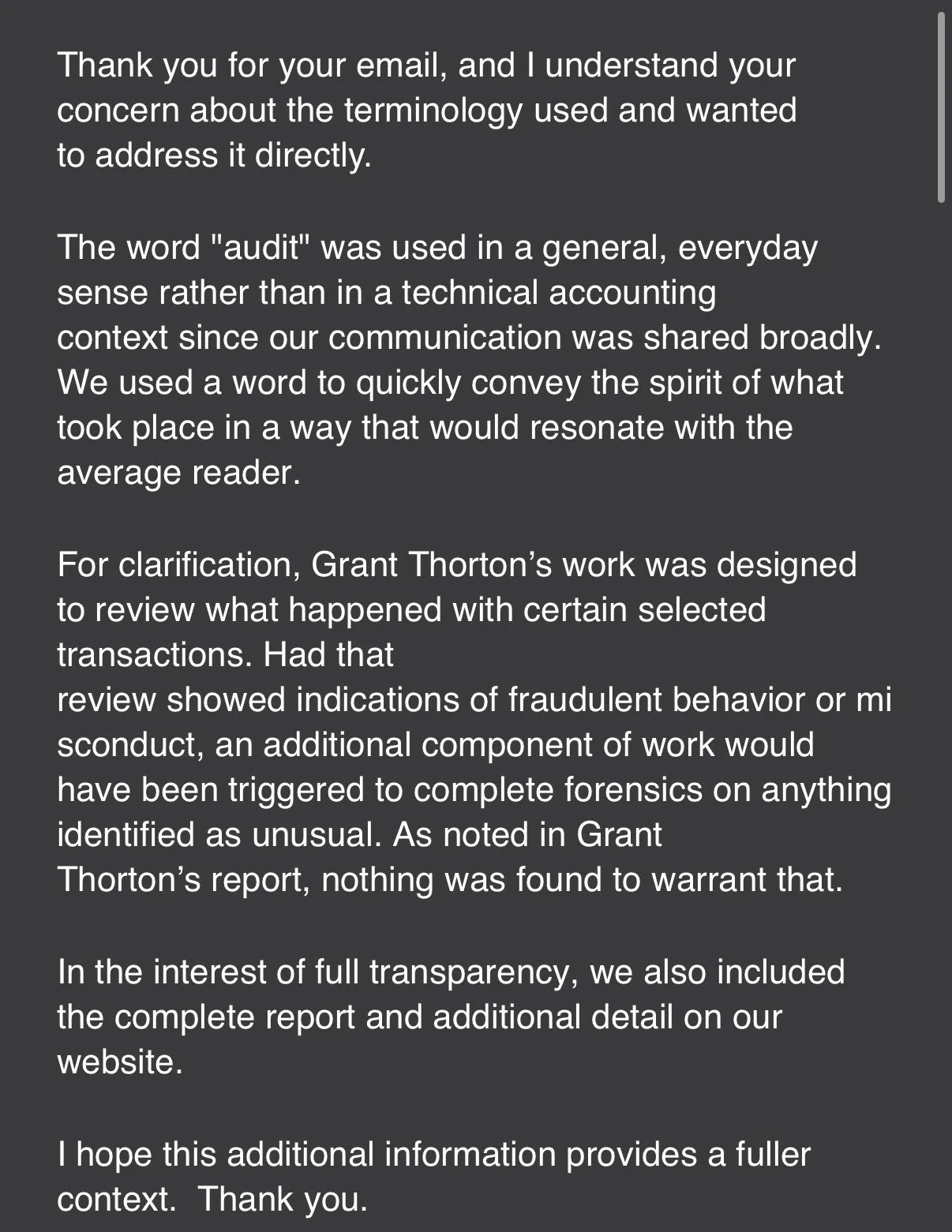
That clarification addresses the terminology, but not the broader concern: whether a limited advisory review was an appropriate basis for publicly declaring there had been no fraud or intentional misconduct.
Fullerton Transparency’s assessment
Fullerton Transparency’s position is that the City’s June 18 public statement was materially misleading.
The City presented a limited advisory review as an “independent financial audit” and emphasized findings that appeared to clear the City of fraud and intentional misconduct, while omitting contractual limitations that would have substantially changed how residents interpreted those claims.
Fullerton Transparency has characterized the post as propaganda because it selectively presented reassuring conclusions while withholding the most important qualifications about the scope and nature of the engagement.
This characterization does not allege that Grant Thornton fabricated its findings or that City employees necessarily acted with criminal intent. It concerns the accuracy and completeness of the City’s public communication.
What the records establish
The available records establish that:
The City initially requested an expedited financial consulting review.
Fullerton contracted with Grant Thornton Advisors LLC.
The governing documents identify the work as advisory services.
Grant Thornton Advisors is not the Grant Thornton entity that provides audit and attestation services.
Grant Thornton sought information concerning Fullerton’s internal political situation.
Grant Thornton offered Quality & Risk and possible legal assistance concerning the City’s press release.
The City nevertheless publicly announced that an “independent financial audit” had found no fraud or intentional misconduct.
